


There are moments in football when a player becomes so attached to a club that their departure leaves a void nobody else can fill. The number on their back becomes sacred, a permanent reminder of what they gave to the supporters who adored them.
Birmingham City recently retired the number 22 after Jude Bellingham left for Borussia Dortmund. The teenager had barely scratched the surface of his career, yet the gesture showed how deeply he had already connected with the club and its fans.
Retiring a shirt number remains one of the rarest honors in football. Clubs reserve this tribute for players who transcend statistics and trophies, those who fundamentally change what it means to wear the badge.
These numbers hang in stadiums as symbols, untouched and preserved, telling stories that get passed down through generations of supporters.
So which clubs have retired the most famous numbers, and which players earned that eternal recognition? Here are 20 of the most notable retired jersey numbers in football history.
- 20. Marc-Vivien Foé, No. 23, Manchester City
- 19. Emiliano Sala, No. 9, Nantes
- 18. Andrés Escobar, No. 2, Atlético Nacional
- 17. George Weah, No. 14, Liberia National Team
- 16. Alessandro Lucarelli, No. 6, Parma
- 15. Darijo Srna, No. 33, Shakhtar Donetsk
- 14. Giacinto Facchetti, No. 3, Inter Milan
- 13. Franz Beckenbauer, No. 5, Bayern Munich
- 12. Ferenc Puskás, No. 10, Budapest Honvéd
- 11. Javier Zanetti, No. 4, Inter Milan
- 10. Davide Astori, No. 13, Fiorentina and Cagliari
- 9. Bobby Moore, No. 6, West Ham
- 8. Valentino Mazzola, No. 10, Torino
- 7. Franco Baresi, No. 6, AC Milan
- 6. Paolo Maldini, No. 3, AC Milan
- 5. Pelé, No. 10, Santos
- 4. Francesco Totti, No. 10, AS Roma
- 3. Gaetano Scirea, No. 4, Juventus
- 2. Johan Cruyff, No. 14, Ajax
- 1. Diego Maradona, No. 10, Napoli
20. Marc-Vivien Foé, No. 23, Manchester City

Manchester City retired the number 23 shirt following the tragic death of Marc-Vivien Foé during a Confederations Cup match in 2003.
The Cameroonian midfielder collapsed on the pitch and passed away, sending shockwaves through the football world. Though he was only on loan at City from Lyon, the club felt a deep connection to him and wanted to honor his memory permanently.
Foé had made a significant impact during his time in Manchester, becoming a fan favorite with his energy and commitment.
The decision to retire his number demonstrated that a player’s impact can sometimes extend beyond their on-pitch achievements. It showed that clubs remember the people behind the jerseys, and that some losses cut too deep to simply move on from.
19. Emiliano Sala, No. 9, Nantes
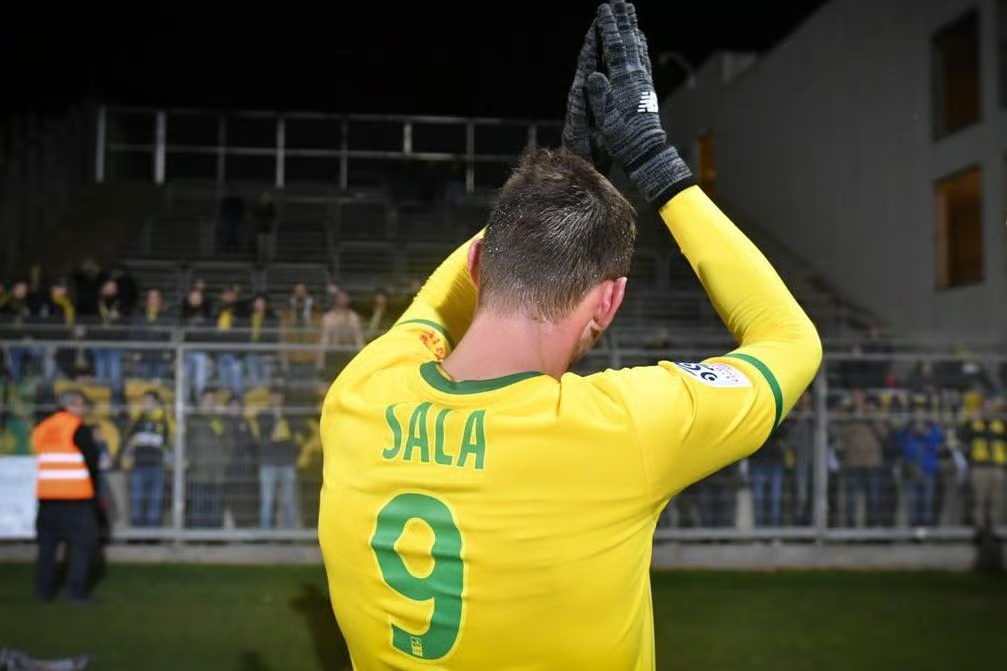
Nantes retired the number 9 shirt in February 2019 following the tragic death of Emiliano Sala. The Argentine striker had just completed a club-record transfer to Cardiff City when the plane carrying him and pilot David Ibbotson disappeared over the English Channel on January 21, 2019.
The wreckage was found days later, and when his body was recovered and identified, the football world mourned.
Sala had spent four years at Nantes, becoming their top scorer for three consecutive seasons and winning the hearts of supporters with his work ethic and kindness. He scored 42 goals in Ligue 1 for the club, with 12 coming in just 19 appearances in his final season.
Nantes president Waldemar Kita announced the retirement, saying Sala would forever be among the legends who wrote the great history of the club. The tragedy reminded everyone that football, for all its importance, pales in comparison to human life.
SEE ALSO | 10 Premier League Records That May Never Be Broken After Haaland’s 100-Goal Feat
18. Andrés Escobar, No. 2, Atlético Nacional
Atlético Nacional retired the number 2 shirt following the murder of Andrés Escobar in 1994, just days after he scored an own goal for Colombia at the World Cup. The defender had been a beloved figure at Nacional, helping them win multiple domestic titles and the Copa Libertadores.
His death shocked Colombia and the world, highlighting the dark side of football when passion turns to violence. Nacional chose to retire his number as a way of saying that Escobar would always be remembered for who he was, not for a mistake on the biggest stage.
The number 2 now serves as a tribute to a player taken far too soon and a reminder of why we need to keep perspective in this sport.
17. George Weah, No. 14, Liberia National Team
George Weah had his number 14 shirt retired by the Liberia national team in September 2018 during an emotional ceremony at the Samuel Kanyon Doe Sports Complex.
The occasion was made even more special because Weah, then serving as President of Liberia at age 51, came out of retirement for one final international friendly against Nigeria.
Weah wore the number 14 throughout his international career, representing Liberia 75 times and scoring 18 goals. He remains the only African player to win the Ballon d’Or and FIFA World Player of the Year, achievements he earned in 1995.
The retired number represents more than just his footballing brilliance at clubs like AC Milan and Paris Saint-Germain. It stands as a symbol of what he meant to a nation that saw him as their greatest sporting hero and later elected him as their president.
16. Alessandro Lucarelli, No. 6, Parma
Parma retired the number 6 shirt when Alessandro Lucarelli announced his retirement in May 2018. The gesture recognized something extraordinary, a level of loyalty that has become almost mythical in modern football. When Parma suffered financial collapse in 2015 and were demoted to Serie D, the fourth tier of Italian football, every single player left. Every single one except Lucarelli.
The defender stayed with the club despite surely having offers from Serie A teams. He took a massive pay cut and led Parma through three consecutive promotions, from Serie D to Lega Pro to Serie B and finally back to Serie A.
He retired at age 40, having fulfilled his promise to bring the club back to where it belonged. Parma had been around for over a hundred years, but they had never retired a number before Lucarelli.
15. Darijo Srna, No. 33, Shakhtar Donetsk
Shakhtar Donetsk retired the number 33 shirt in 2018 when Darijo Srna left after 15 years at the club.
The Croatian right-back made 536 appearances, won seven Ukrainian Premier League titles, and captained Shakhtar to UEFA Cup glory in 2009. He stayed through the Donbass war when leaving would have been easier, proving his loyalty transcended football.
Srna now serves as the club’s sporting director, with the retired number 33 representing the first in Shakhtar’s history.
14. Giacinto Facchetti, No. 3, Inter Milan
Inter Milan retired the number 3 shirt following the death of Giacinto Facchetti in 2006. The defender spent his entire 18-year career at the club, making over 630 appearances and redefining what a full-back could do on the pitch.
He captained Inter for years and remained connected to the club long after hanging up his boots, eventually becoming their president.
Facchetti represented everything Inter valued. His loyalty, leadership, and revolutionary style of play made him more than just a great player. He was the embodiment of the club itself.
When he passed away, retiring his number felt like the only appropriate response. The number 3 at Inter now serves as a constant reminder of the man who wore it with such distinction for nearly two decades.
SEE ALSO | Greatest Football Upsets Ever: 20 Shocking Underdog Wins in History
13. Franz Beckenbauer, No. 5, Bayern Munich
Bayern Munich retired the number 5 shirt in December 2024, less than a year after the death of Franz Beckenbauer. The decision was announced at the club’s annual general meeting, with president Herbert Hainer declaring that Beckenbauer would forever remain their Kaiser.
His widow Heidi and son Joel were present for the emotional ceremony.
Beckenbauer revolutionized the sweeper position with his intelligence and passing ability. He won four Bundesliga titles with Bayern, three consecutive European Cups from 1974 to 1976, and captained West Germany to World Cup glory in 1974.
He later managed Germany to another World Cup triumph in 1990. The number 5 represents not just an incredible player, but the man who helped transform Bayern into the powerhouse they are today. A giant shirt bearing his name and number now hangs permanently under the roof of the Allianz Arena.
12. Ferenc Puskás, No. 10, Budapest Honvéd
Budapest Honvéd retired Ferenc Puskás’ number 10 shirt in 2000, after the legendary forward was diagnosed with Alzheimer’s disease. Puskás spent 13 years with the club, scoring an astonishing 382 goals in 367 appearances.
He became known as the Galloping Major due to his rank in the Hungarian army, which had acquired the club.
Puskás was one of the greatest goalscorers in football history, leading Hungary to the 1952 Olympic gold medal and the 1954 World Cup final. After the Hungarian Revolution forced him to flee the country, he joined Real Madrid, where he continued his brilliance for another eight years.
11. Javier Zanetti, No. 4, Inter Milan

Inter Milan officially retired the number 4 shirt on May 4, 2015, during a charitable match at the San Siro organized by Javier Zanetti himself.
The Argentine had spent 19 seasons at the club, making 858 appearances and becoming the player with the most games in Inter’s history. He captained the team for 13 of those years.
Zanetti arrived at Inter in 1995 as a 22-year-old with his shoes in a plastic bag and retired at 40 with a teary San Siro crowd honoring him. He won 16 trophies with the club, including five Serie A titles and the historic treble in 2010 when Inter became the only Italian club to win the league, Coppa Italia, and Champions League in the same season.
SEE ALSO | 20 Best Attacking Midfielders in 2025
10. Davide Astori, No. 13, Fiorentina and Cagliari
Both Fiorentina and Cagliari jointly retired the number 13 shirt on March 6, 2018, just days after Davide Astori died suddenly in his sleep.
The 31-year-old Fiorentina captain was staying in a Udine hotel ahead of a match when he passed away from cardiac arrest. The news sent shockwaves through Italian football and beyond.
Astori had played 178 times for Cagliari and made 109 appearances for Fiorentina. He wore the number 13 as a tribute to his idol Alessandro Nesta, who had worn the same number throughout his career.
All Serie A matches that weekend were postponed out of respect. Fiorentina later renamed their training ground Centro Sportivo Davide Astori and held a minute’s pause at the 13-minute mark of their next home match.
9. Bobby Moore, No. 6, West Ham
West Ham waited until 2008 to officially retire the number 6 shirt, decades after Bobby Moore last wore it for the club. The delay made sense in a way.
Moore had passed away in 1993, and the club wanted to ensure the tribute felt right, that it properly captured the magnitude of what he represented, not just to West Ham, but to English football as a whole.
Moore captained England to their only World Cup triumph in 1966, delivering performances that showcased his reading of the game, his composure, and his ability to lead.
His statue now stands outside the London Stadium, and his number hangs retired alongside it, twin monuments to the greatest defender England has ever produced.
8. Valentino Mazzola, No. 10, Torino
Torino retired the number 10 shirt in memory of Valentino Mazzola, the captain who perished along with the entire Grande Torino team in the Superga air disaster of 1949.
Mazzola was not only the heart of Torino but also one of the best players in Italian football at the time. The tragedy robbed Italian football of an entire generation of talent.
The retired number serves as a memorial to Mazzola and all those who died that day.
Torino has never fully recovered from the loss, and the number 10 stands as a permanent reminder of what could have been.
7. Franco Baresi, No. 6, AC Milan
AC Milan retired the number 6 shirt when Franco Baresi retired in 1997 after spending his entire 20-year career at the club. He made 719 official appearances for Milan, winning six Serie A titles, three European Cups, and countless other honors.
He captained the team for 15 seasons and was voted Milan’s Player of the Century in 1999.
Baresi revolutionized defensive play with his reading of the game, positioning, and ability to start attacks from the back. He formed one of the most formidable defensive units of all time alongside Paolo Maldini, Alessandro Costacurta, and Mauro Tassotti. When he finally hung up his boots at age 37, Milan knew that nobody could ever wear that number again.
SEE ALSO | 10 Most Iconic Jersey Numbers in Soccer Players Love Wearing
6. Paolo Maldini, No. 3, AC Milan
When you spend your entire 25-year career at one club, make 902 appearances, win 26 major trophies, and redefine your position for generations to come, your jersey number becomes more than fabric and digits. Paolo Maldini embodied everything AC Milan stood for.
He captained the team with grace, defended with intelligence and elegance, and never once considered wearing another club’s colors.
Milan retired his number 3 shirt when he finally hung up his boots in 2009, though they made one exception. Maldini gave his consent for his sons to wear the number 3 if they ever played professionally for the club. That gesture captured the essence of what Maldini meant to Milan, a legacy so powerful it could be passed down through bloodlines.
5. Pelé, No. 10, Santos
Santos temporarily retired the number 10 jersey in 2023 when they were relegated from the Brazilian Serie A for the first time in the club’s 111-year history. It was a symbolic gesture, a way of saying that without the standard Pelé set, the club had fallen too far.
The number would remain unworn until Santos returned to where they belonged.
That return came quickly, and when it did, the club gave the number to Neymar, arguably the second-greatest player in Santos history. The decision to make the retirement temporary rather than permanent showed a different kind of reverence.
Pelé remains the king of football, the player who put Santos on the global stage and won everything there was to win while wearing that number. But by allowing it to be worn again, by someone worthy, Santos kept the spirit of the number 10 alive rather than locking it away forever.
4. Francesco Totti, No. 10, AS Roma

Francesco Totti spent 25 years at Roma, becoming more than just their greatest player. He became the personification of the club, the city, and what it means to stay loyal when the world tries to pull you away.
Roma retired his number 10 jersey when he finally retired in 2017, a decision that surprised nobody who had watched him dedicate his entire career to the Giallorossi.
Totti won a World Cup with Italy, claimed a Serie A title with Roma, and scored over 300 goals for the club. But the numbers only tell part of the story. He turned down moves to Real Madrid, to the Premier League, to anywhere that would have paid him more or offered him more trophies. He chose Roma every single time.
SEE ALSO | The 10 Greatest Last-Minute Goals in Soccer History
3. Gaetano Scirea, No. 4, Juventus
Juventus retired the number 4 jersey following the tragic death of Gaetano Scirea in a car accident in 1989.
The defender had spent his entire 14-year career at the club, winning every major honor available and establishing himself as one of the most elegant defenders Italian football had ever produced.
Scirea was the antithesis of the typical Italian defender.
He rarely picked up bookings, preferring to read the game and position himself perfectly rather than resorting to tough tackles. He captained Juventus to European Cup glory in 1985 and won seven Serie A titles with the club.
2. Johan Cruyff, No. 14, Ajax
Ajax officially retired the number 14 shirt in 2007 to celebrate Johan Cruyff’s 60th birthday. They could have done it decades earlier, and nobody would have questioned the decision. Cruyff revolutionized football both as a player and a manager, and much of that revolution began at Ajax.
He won three consecutive European Cups with the club in the early 1970s, pioneering the total football philosophy that changed how the game was played across the continent.
His vision, technical ability, and understanding of space made him unlike any player who came before him. Ajax later named their stadium the Johan Cruyff Arena, adding another layer to his legacy. The number 14 hangs in that arena now, a reminder that some players do more than win trophies.
1. Diego Maradona, No. 10, Napoli

When Maradona arrived at Napoli in 1984, the club had never won a Serie A title. Southern Italian teams were looked down upon by the traditional northern powerhouses. Napoli existed in the shadow of Juventus, AC Milan, and Inter Milan, always competitive but never quite good enough to break through.
Then Maradona changed everything. He led Napoli to their first-ever Serie A title in 1987, then did it again in 1990. He won them the UEFA Cup. He turned them from underdogs into champions, from an afterthought into a force that struck fear into every team in Italy.
The city fell in love with him in a way that transcended football. He became their hero, their savior, the man who proved that Napoli could stand alongside anyone.
The club retired his number 10 shirt in 2000, and after he died in 2020, they renamed their stadium the Stadio Diego Armando Maradona. Walking through Naples today, you still see murals of him on building walls, shrines in the narrow streets, his face everywhere you look.
SEE ALSO | 20 Famous Soccer Players Who Suffered ACL Injuries
Honorary Mention: Diogo Jota
In July 2025, just 11 days after marrying his longtime partner, Liverpool forward Diogo Jota tragically died alongside his brother André Silva in a car crash in Spain.
The 28-year-old had scored 65 goals in 182 appearances for Liverpool, helping secure the 2024-25 Premier League title and winning two UEFA Nations League trophies with Portugal.
Liverpool retired Diogo Jota’s 20 shirt number across all levels of the club (men’s, women’s, academy) in honor of the tragically deceased forward, a historic first for the club made after consulting his family, making him forever Liverpool Football Club’s number 20.


