


Which league is better between the Premier League and La Liga has never needed a marketing campaign because the argument sells itself every season, the moment the Champions League anthem echoes across Europe and fans begin measuring leagues through silverware, spectacle, and the feeling in their chest when the stakes are highest.
The comparison sits at the heart of modern football discourse, stretching across television studios, scouting departments, betting markets, and dressing rooms where players admit which competition feels tougher, more unforgiving.
England’s top-flight is chaotic and deep, while Spain’s division trades in control and pedigree; the friction between those identities has shaped the European game for nearly two decades. What makes this debate compelling is not nostalgia or nationalism; however, the evidence available in trophies, talent pipelines, global audiences, tactical innovation, and financial muscle.
Domestic Competitiveness
Premier League: 88%
La Liga: 72%
Winner: Premier League
The Premier League’s defining strength lies in competitive volatility, with multiple clubs entering seasons with realistic ambitions of mounting a title challenge and mid-table teams possessing enough financial and tactical sophistication to upset traditional powers.

Over the past decade and a half, five different champions have emerged in England, ranging from serial winners like Manchester City to the once-in-a-generation surge of Leicester City, whose 2016 triumph recalibrated the idea of what was possible in a league shaped by billion-pound broadcasting deals.
La Liga has produced excellence at the very top, but its domestic division has long been governed by a clear hierarchy dominated by Real Madrid and Barcelona, with Atlético Madrid periodically disrupting the pattern through tactical cohesion and relentless defensive structure.

While this dominance reflects sustained elite standards, it also narrows the realistic path to the title for the rest, where financial disparity often mirrors the league’s standing.
The Premier League earns the higher percentage because unpredictability drives sustained engagement across all 20 clubs, and because relegation battles, European qualification races, and title pursuits often remain alive deep into the spring calendar. La Liga retains strength at thetop, but England’s broader competitive ecosystem gives it the edge in this category.
SEE ALSO | 7 Greatest South Americans To Play In La Liga
European Success
Premier League: 82%
La Liga: 94%
Winner: La Liga
Measured strictly through continental performance since the 2009–10 season, La Liga commands this conversation with authority. Spanish clubs have won 8 Champions League titles in that period, including Real Madrid’s extraordinary run of dominance and Barcelona’s continued presence at the sharp end of the competition.
The stretch between 2014 and 2018, when Spanish sides won every Champions League crown, marked one of the most sustained periods of league-wide supremacy in modern European history.
In the Europa League, Spain’s imprint has been even stronger, with multiple wins from Sevilla and Atlético Madrid reinforcing the idea that tactical preparation and technical composure translate effectively into two-legged knockout formats.
Even when not lifting trophies, Spanish clubs have regularly advanced to semifinals and finals, preserving the league’s continental reputation.
The Premier League has secured four Champions League titles over the same span and has fielded several finalists, demonstrating both depth and resilience, but the overall trophy count tilts heavily toward Spain.
European competition remains football’s most demanding benchmark because it removes domestic familiarity and exposes structural weaknesses, and on that stage, La Liga has delivered more consistently elite outcomes.
Style of Play and Tactical Identity
Premier League: 70%
La Liga: 90%
Winner: La Liga

La Liga’s stylistic legacy rests on technical precision and positional intelligence, on a deep cultural belief that the ball should be treated with care rather than chased like a loose object on the pitch.
That philosophy has shaped the game’s tactical evolution in ways that still ripple across Europe today. The influence of Barcelona’s golden era, combined with Real Madrid’s ability to adapt to any opponent and Atlético Madrid’s fierce yet calculated structure, created a competition where spatial awareness is currency and possession is not vanity but control, rhythm, and ultimately power.
In Spain, even the clubs scrapping near the bottom of the table refuse to surrender the ball, preferring instead to build through midfield, to trust their technique, and to believe that football should be played through combinations rather than hopeful launches into crowded penalty areas.
Relegation-threatened sides still attempt triangles in tight corridors, still ask their defenders to step into midfield with composure, still demand that their midfielders receive under pressure and turn rather than just clear their lines and reset for the next aerial duel.
There is an aesthetic stubbornness to La Liga, a refusal to reduce the sport to chaos, and it gives the league a continuity of style that runs from title contenders to those fighting for survival.
Players raised in Spanish academies are shaped by that environment, taught from an early age that the first touch must invite the next pass, that movement without the ball matters as much as any run, and that the pitch is a map of angles waiting to be explored.
Their comfort under pressure is not accidental but rehearsed, the product of countless sessions where the ball is kept on the pitch, and decisions are sharpened through repetition. This technical grounding has traveled beyond Spain, influencing national teams and club sides across continents, exporting a football language built on patience, geometry, and imagination.
The Premier League often feels like a different football altogether, one where throw-ins are treated like corner kicks, where long diagonal balls are applauded as tactical boldness, and where set pieces can dominate entire game plans as if they were the primary route to creativity rather than a supplement to it.
Of course, there is intensity and there is athletic brilliance, but too often the rhythm resembles a track meet interrupted by stoppages rather than smooth, controlled movement. Pressing becomes a frenzy, transitions replace construction, and matches swing on second balls and rehearsed routines rather than carefully constructed patterns that pull defenses apart.
England’s top flight celebrates physical confrontation and verticality, while managers have introduced layered positional structures and complicatd build-up phases, the league’s default setting still leans toward force over finesse.
Corners are weaponized, long throws become tactical events, and towering center-backs are prized as much for attacking the six-yard box as for defending it. The spectacle can be gripping, but it often trades subtlety for spectacle, leaving little room for the kind of measured orchestration that defines Spain’s finest evenings.
SEE ALSO | 10 Most Underrated Players In Premier League History
Financial Power and Commercial Reach
Premier League: 96%
La Liga: 75%
Winner: Premier League
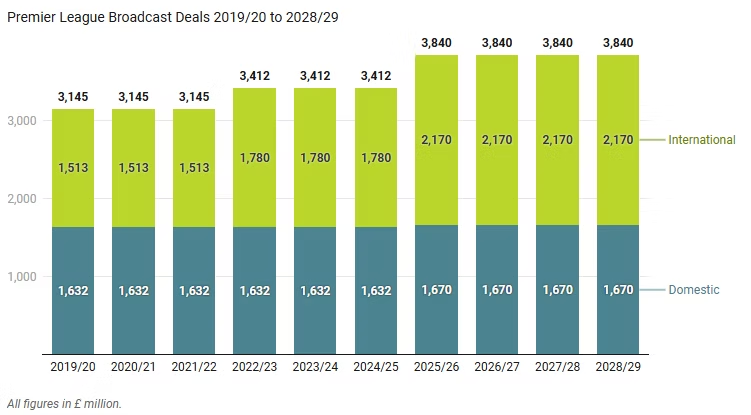
Commercial infrastructure defines modern football as much as tactics do, and in this angle, the Premier League operates from a position of extraordinary strength. Its broadcasting agreements extend into over 200 territories, generating revenue that flows not only to title contenders but also to clubs fighting relegation.
This financial distribution model sustains competitive balance and funds world-class facilities, analytics departments, and recruitment networks.
La Liga remains commercially potent, anchored by globally recognized brands such as Real Madrid and Barcelona, whose individual reach rivals that of entire leagues. However, historical revenue concentration among its top two clubs has created structural imbalances that the league has only recently begun to address through centralized television rights reforms.
The Premier League’s financial scale influences player acquisition, wage structures, and global marketing strategies, reinforcing its visibility across Asia, North America, and Africa.
While La Liga maintains deep roots in Latin America and parts of Europe, England’s economic dominance leads in this category.
SEE ALSO | Appointment of Referees In La Liga: An In-Depth Look
Talent Development and Export Value
Premier League: 87%
La Liga: 90%
Winner: La Liga
Spain’s academy systems have long been admired for producing technically adept players capable of adapting to various tactical frameworks. The development of midfielders comfortable dictating tempo and defenders trained in ball progression reflects a philosophy that prioritizes understanding the game at its most complex level.
English football once criticized for lagging in youth cultivation, has undergone systemic reform, investing heavily in coaching education and sports science. The result is a generation of players who blend athletic explosiveness with tactical maturity, elevating both club and national performances.
La Liga edges this category slightly due to its historical consistency in shaping technically complete footballers who influence tactical trends; still, the Premier League’s academy new age signals that this margin may continue to narrow.
Global Popularity and Cultural Influence
Premier League: 98%
La Liga: 75%
Winner: Premier League
In terms of worldwide audience engagement, merchandise sales, and social media following, the Premier League commands unmatched scale.
Its scheduling strategy, language accessibility, and marketing infrastructure have embedded it deeply into markets across Asia and North America, creating generational loyalty far beyond England’s borders.
La Liga retains strong cultural resonance in Spanish-speaking regions and continues to attract viewers through historic rivalries and star power, but its overall numerical footprint trails that of England’s top flight.
Popularity does not equal superiority in technical terms; it shapes perception, sponsorship potential, and long-term sustainability, giving the Premier League a measurable advantage here.
Best Players of the Modern Era
Premier League: 90%
La Liga: 96%
Winner: La Liga
La Liga’s modern golden age coincided with perhaps the most iconic individual rivalry football has ever seen, when Lionel Messi and Cristiano Ronaldo shared the same domestic stage while performing at levels that distorted statistical norms and redefined expectations for forwards.
Messi’s artistry at Barcelona blended vision, dribbling, and goal scoring into a complete attacking language, while Ronaldo’s transformation at Real Madrid produced relentless output in domestic and European competition.
Apart from that rivalry, Spain’s top division has showcased players such as Xavi, Andrés Iniesta, Luka Modrić, Karim Benzema, Neymar, and De Lima, all of whom shaped tactical eras and delivered decisive performances on the biggest stages.
The technical environment of La Liga allowed midfielders and attackers to flourish within structured systems that emphasized intelligence and spatial awareness.
The Premier League’s elite tier has been equally compelling, though its brilliance has often been more distributed across clubs and seasons. Thierry Henry’s elegance at Arsenal, Cristiano Ronaldo’s early evolution at Manchester United, Kevin De Bruyne’s creative authority at Manchester City, Mohamed Salah’s consistency at Liverpool, and Erling Haaland’s record-breaking scoring have defined different chapters of English football’s recent history.
What separates La Liga in this category is the simultaneous presence of two all-time greats in their absolute primes, competing weekly in the same competition and elevating the league’s aura.
That sustained head-to-head excellence grants Spain a narrow but meaningful edge.
SEE ALSO | Every Premier League Club’s Record Transfer Sale In History
Ballon d’Or Influence
Premier League: 70%
La Liga: 99%
Winner: La Liga
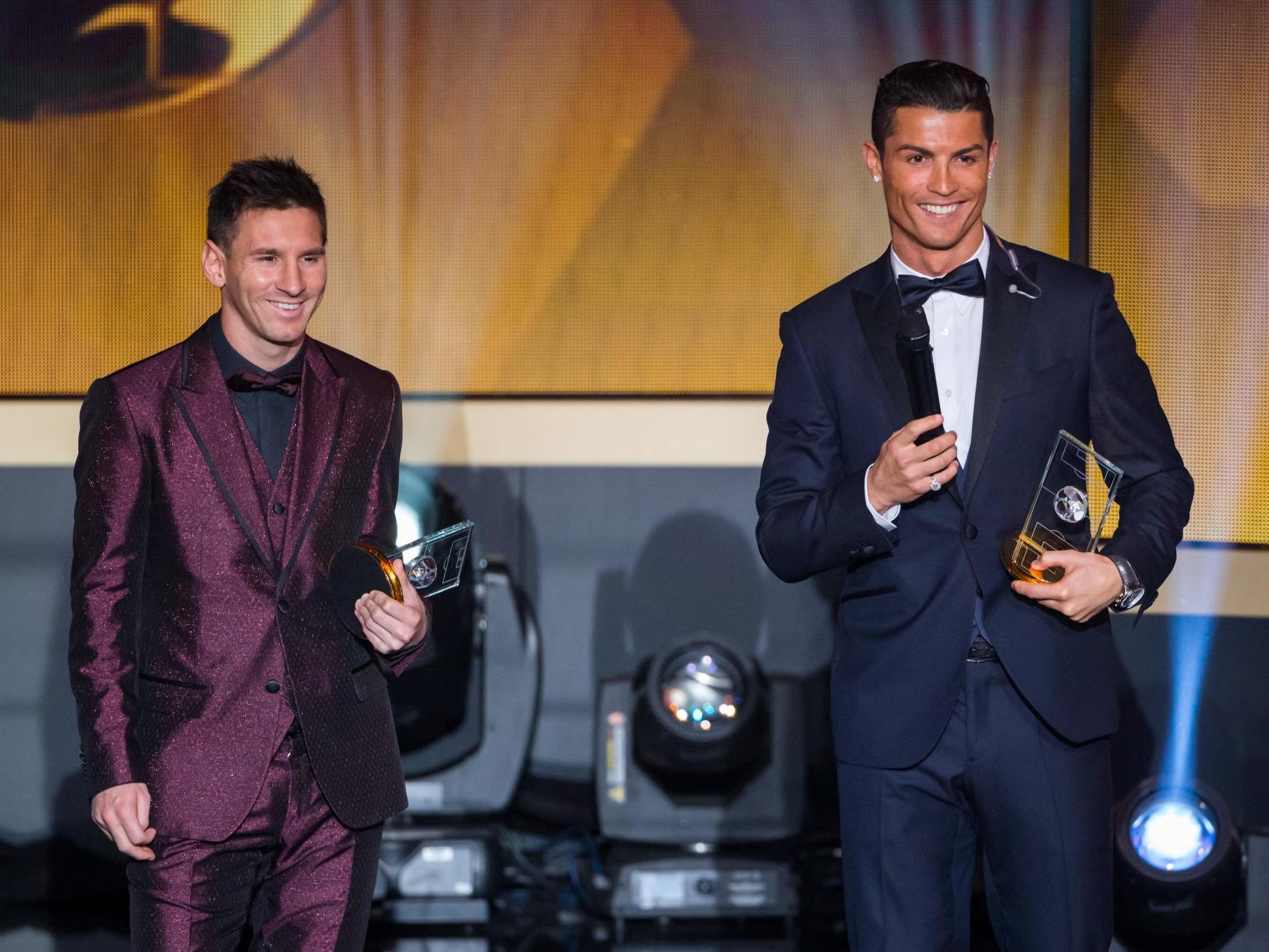
The Ballon d’Or serves as football’s most recognized individual honor, and its distribution over the past two decades strongly favors Spain’s top division. From 2009 onward, the majority of winners were playing in La Liga at the time of their win, with Messi and Ronaldo dominating the award during their years in Barcelona and Real Madrid, respectively.
Luka Modrić’s 2018 win while at Real Madrid and Karim Benzema’s 2022 recognition further extended La Liga’s influence in individual accolades.
During the Messi-Ronaldo era, the award effectively became a referendum on performances delivered in Spanish stadiums and Champions League nights anchored by La Liga clubs.
The Premier League has had Ballon d’Or winners, though fewer during the modern stretch. Cristiano Ronaldo won the award in 2008 while at Manchester United, and the league has regularly placed players high in the voting; it has not monopolized the award in the same way Spain did for over a decade.
This imbalance reflects not a shortage of talent in England but the extraordinary statistical peaks achieved by La Liga’s superstars during that era.
For more than ten years, the Ballon d’Or conversation revolved around performances delivered primarily within European competition, cementing La Liga’s dominance in this category.
SEE ALSO | 25 Best Premier League Penalty Takers
Current Global Superstars
Premier League: 94%
La Liga: 88%
Winner: Premier League
While history leans toward Spain, the present moment tilts slightly toward England in terms of concentrated star power across multiple clubs. The Premier League currently hosts a broad array of elite performers in their prime, from dynamic forwards to commanding midfielders and dominant defenders, spread across several title contenders.
This distribution improves weekly competitiveness and ensures that high-profile clashes occur regularly throughout the season.
England’s financial strength also allows clubs outside the traditional top 6 to recruit internationally recognized talents, deepening the league’s overall star density.
La Liga continues to produce and attract exceptional players, and its emerging generation carries immense promise. The concentration of superstars is less evenly spread than during its Messi-Ronaldo peak.
SEE ALSO | Top 5 Most Successful Football Clubs In La Liga
Our Verdict
Aggregating the categories reveals a tightly contested rivalry shaped by different strengths. La Liga dominates European competition and sustains a stylish identity that has influenced tactical discourse for decades.
The Premier League thrives in competitive balance, financial muscle, and global engagement, building an ecosystem that feels expansive and unpredictable.
The debate over which league is better resists a general conclusion because superiority depends on the criteria. If continental trophies and tactical influence define excellence, La Liga holds the upper hand. If competitive volatility, economic strength, and strength determine leadership, the Premier League stands tall here.
What remains undeniable is that these two leagues have set the benchmark for modern football, driving each other toward higher standards and ensuring that the debate, like the beautiful game itself, continues without a final whistle.


