

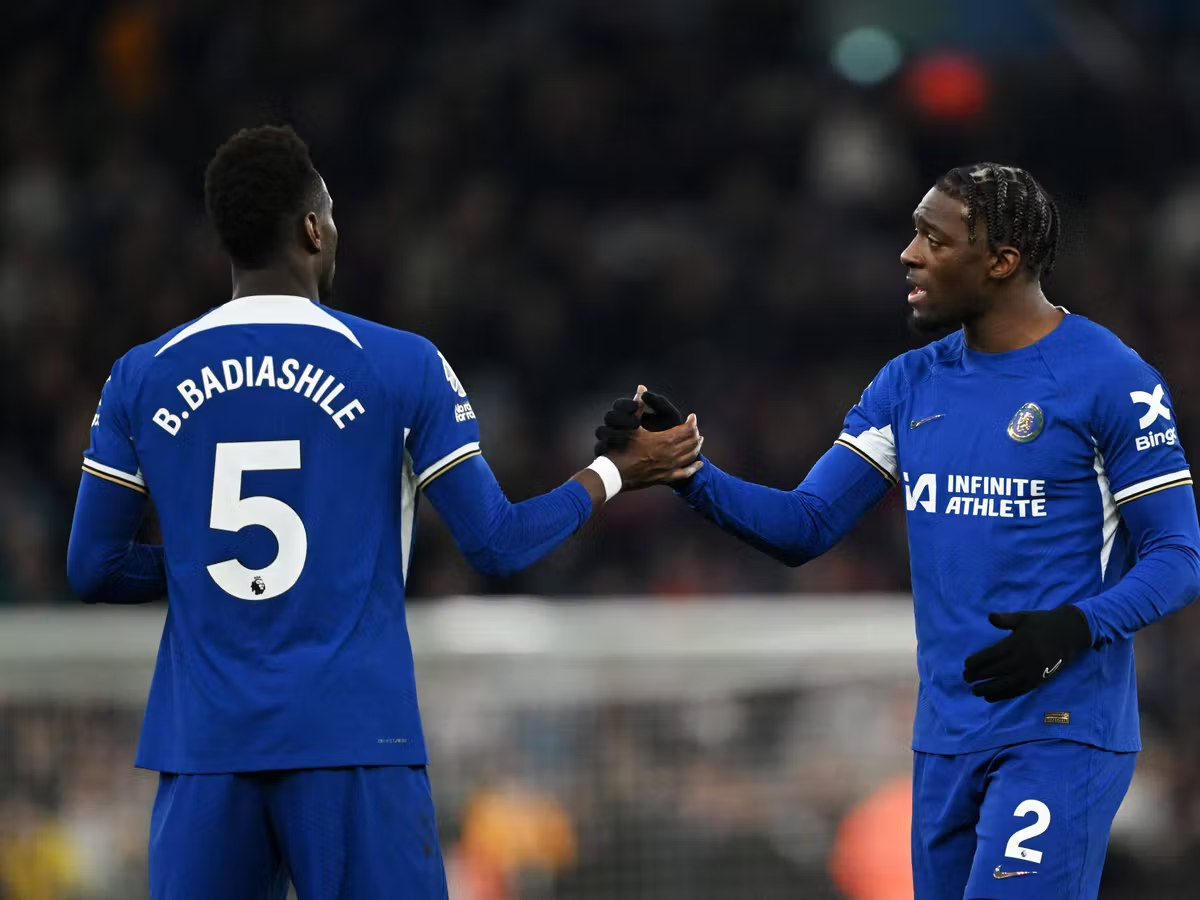
Chelsea has long been defined by its defensive identity, a club that built dynasties around players capable of dominating the heart of the pitch, reading the game, and commanding respect through physicality and intelligence.
From the gritty, uncompromising days of the mid-2000s to Antonio Conte’s tactical mastery, the Premier League demanded center-backs who could manage pace, power, and precision. Champions were forged on these principles, yet every era leaves shadows, and Chelsea’s history is littered with central defenders whose arrival promised competence but delivered chaos, inconsistency, or unexplainable disengagement.
Identifying the “worst” players in a club’s history is naturally subjective, as it depends on whether you value technical performance, transfer fee vs. output, or professional conduct.
At Chelsea, many of the most criticized center-backs were either high-profile signings who failed to adapt or players whose off-field sagas overshadowed their defensive contributions.
Some were misjudged acquisitions, others misfired due to temperament.
10. Malang Sarr (2020–2024)

Sarr arrived with the aura of potential: young, free from Nice, experienced in Ligue 1, and a former captain. On paper, he was the type of defensive project Chelsea could develop slowly. On the pitch, Sarr exuded panic in slow motion, a man whose indecision spread through the backline like a virus.
Under Thomas Tuchel, Sarr operated in a back three designed for fluidity, anticipation, and aerial dominance. Still, he lacked the size to assert himself against strikers and the speed to cover mistakes.
In games against pressing sides like Liverpool or Manchester City, he often found himself bypassed, leaving wide gaps for attackers to exploit. One illustrative example was against Leicester in 2022, where a simple lateral ball into his zone allowed Jamie Vardy to turn and score, Sarr frozen in the center as if hoping the referee might intervene.
Chelsea responded with loans, rotations, and cautious starts, but nothing stabilized his trajectory.
By the time he left for Lens, Sarr had never looked like a player capable of anchoring a Premier League backline, serving as a stark reminder that talent alone cannot compensate for positional uncertainty and panic under pressure.
SEE ALSO | 20 Forgotten Players Who Once Played for Chelsea
9. Benoit Badiashile (2023–Present)

Badiashile arrived with the blueprint for modern defensive perfection: towering height, a commanding left foot, and a reputation as a calm ball-playing center-back.
He seemed tailor-made for Chelsea’s system, designed to control play from the back while providing a physical presence. Reality, however, told a different story.
Badiashile’s primary flaw is mental: the precise moment when concentration must be absolute is often when he disengages. He has been caught ball-watching while attackers ghost behind him, letting crosses sail unchallenged.
Against Tottenham in 2023, he inexplicably drifted five yards out of position, allowing a simple pull-back for Harry Kane to score.
His size, pace, and technique suggest a solution, but repeated lapses illustrate a fundamental problem: the brain isn’t keeping up with the body. Chelsea’s fans quickly became frustrated, seeing potential squandered as mere flashes rather than consistency.
8. Papy Djilobodji (2015–2016)

Few Chelsea acquisitions are as absurd as Djilobodji.
In 2015, desperate for defensive reinforcement after failing to secure John Stones, Chelsea brought in a player Jose Mourinho had never scouted. Djilobodji’s Chelsea career lasted all of 60 seconds in the League Cup against Walsall before fading into irrelevance, a brief cameo in a career that was notable for its absence rather than performance.
He exemplifies the panic buy: a man signed to satisfy a registration list rather than to fortify a defense. There was no integration, no development, and absolutely no impact.
Djilobodji became the punchline of Chelsea transfer lore, a player who reminded the world that even clubs with astronomical budgets can make baffling errors.
SEE ALSO | Chelsea Wages Revealed: Every Player’s Salary in 2025/26 Season
7. Matt Miazga (2016–2022)

Miazga’s leap from MLS to Chelsea’s first team was always going to be daunting. Injuries forced him into the squad against Swansea, a baptism that quickly became a nightmare.
He struggled with Premier League physicality and pace, leaving gaps and failing to read attacking runs. His errors led directly to conceding opportunities, undermining the team’s defensive shape and morale.
Chelsea then cast him into the loan system, where he drifted through Vitesse, Nantes, Reading, Anderlecht, and Alavés, never establishing himself at Stamford Bridge.
His tenure embodies what happens when raw talent meets a league that offers no mercy: promise unfulfilled, potential wasted, and a name that surfaces only when discussing failed defenders rather than competent professionals.
6. Tal Ben-Haim (2007–2008)

Tal Ben-Haim arrived as a squad player, ostensibly to back up John Terry and Ricardo Carvalho. Ben-Haim could not grasp the subtlety of supporting roles. His career at Chelsea is remembered less for defending and more for complaints about a lack of minutes.
He was unable to assert dominance against mid-table strikers, struggled with positional discipline, and often generated anxiety within the team.
His departure after 13 appearances to Manchester City closed the chapter on a player whose presence served more to distract than to stabilize.
Chelsea fans recall him as a symbol of mismanaged expectations.
5. Tosin Adarabioyo (2024–Present)

Tosin was signed as a stabilizing force, a veteran presence in a young defense post-Tiago Silva. Still, leadership and presence must be paired with reliable performance, and Tosin often looks a step behind, misjudging transitions and allowing attackers to exploit hesitation.
His tenure includes high-profile errors in matches against Manchester City and Arsenal, moments where the ball drifts past him, leaving teammates scrambling.
Chelsea expected consistency; what they received was intermittent solidity mixed with costly mistakes. Tosin remains a competent player in flashes but lacks the commanding authority required at Stamford Bridge, a stopgap rather than a lynchpin.
SEE ALSO | Chelsea: 7 Best Premier League Top Scorers In History
4. Axel Disasi (2023–Present)

Disasi arrived with the physical credentials of a Premier League powerhouse, yet his play consistently invites chaos. While he exudes energy and effort, the execution often fails.
Disasi celebrates routine tackles as if they were trophies, only to misread subsequent movements, leaving the backline exposed.
His own goal against Leicester, a thirty-yard lob that sailed over the goalkeeper, was emblematic of his Chelsea tenure: high-profile, high-energy, and entirely avoidable.
He makes simple defensive responsibilities seem impossible, providing a constant source of uncertainty. His presence often destabilizes rather than reinforces, a stark reminder that size and energy do not compensate for tactical awareness.
3. Jeffrey Bruma (2009–2013)

Jeffrey Bruma arrived as Chelsea academy’s hope, a physically imposing player with technical refinement. His mental application faltered under Premier League demands.
He repeatedly misjudged positioning, mistimed interventions, and could not adjust to the pace of England’s top flight.
One illustrative moment occurred against Arsenal in 2011, where his hesitation allowed a simple cross to find the unmarked striker, resulting in a goal. His potential was evident but never consistently applied.
Eventually sold to PSV, he rebuilt his career abroad, but Chelsea fans remember him as a lesson in the gulf between youth promise and first-team readiness.
SEE ALSO | 10 Record-Breaking Transfers That Turned Into Massive Flops
2. Slobodan Rajkovic (2007–2011)

Rajkovic represents one of Chelsea’s most expensive non-performers. Signed at 16 for millions, work permit complications kept him from England for years. He spent four years on loan across Europe and gained notoriety for a year-long ban after spitting at a referee during the Olympics.
By the time he could have contributed, his development stagnated.
Chelsea spent vast sums with no return, leaving Rajkovic as a warning about bureaucratic and scouting missteps. He never played a competitive game for the first team, an investment that produced only paperwork, speculation, and fan incredulity.
1. Winston Bogarde (2000–2004)

Bogarde is the ultimate example of defensive failure at Chelsea. Signed on a huge contract at the end of the Vialli era, he was deemed surplus by Claudio Ranieri but responded by staying for four years, collecting wages, and making twelve appearances while actively avoiding contribution.
He transformed Stamford Bridge into a lesson in apathy. He refused engagement, treating the club as a high-paying gym membership rather than a professional environment.
His tenure cost the club roughly £15 million in wages with minimal return, creating one of the most infamous examples of financial and strategic mismanagement in Premier League history.
Honourable Mentions
- Khalid Boulahrouz (2006–2008)
- Kalidou Koulibaly (2022–2023)
- Michael Hector (2015–2020)


