


There are moments in football where a result feels final; where the whistle goes, the stadium empties, and you accept that whatever just happened is now written into the record books.
For Nigeria, that moment came in Rabat last November. A penalty shootout, a miss, a roar from the DR Congo players, and the Super Eagles were done. Out. Headed home without a World Cup to look forward to.
Except, possibly, they aren’t. Not yet, anyway.
Months after that deflating night in Morocco, a legal dispute filed quietly by the Nigeria Football Federation has grown into one of the most captivating controversies in African football and, with the intercontinental play-off tournament now just weeks away in Mexico, the noise around it is only getting louder.
How It All Started
Nigeria’s road to the 2026 World Cup was never straightforward. After defeating Gabon 4-1 in the semi-finals of the CAF play-off, the Super Eagles found themselves in a winner-takes-all final against DR Congo. The match in Rabat finished 1-1 after 90 minutes, and when the penalty shootout came, it was the Congolese who kept their nerve. Nigeria lost 4-3 on spot-kicks. Their chance at the World Cup, it seemed, was gone.

It was a brutal way to go out, the kind of elimination that lingers. And it was made all the more painful by the fact that it meant Nigeria were on course to miss out on two consecutive World Cups for the first time since 1994.
While the players began processing the defeat and the fans were left to sit with the grief of it, the NFF were already looking at the match through a different lens.
In December 2025, the NFF filed a formal complaint with FIFA, alleging that DR Congo fielded players who were ineligible under nationality rules. The NFF alleged that up to six DR Congo players were ineligible to play against the Super Eagles in the African Playoff final in November 2025.
The petition, submitted on December 15th, didn’t just challenge a result; it challenged the entire basis on which DR Congo had selected certain players in the first place.
SEE ALSO | Countries That Have Never Qualified for the FIFA World Cup (2025 List)
The Players at the Heart of It
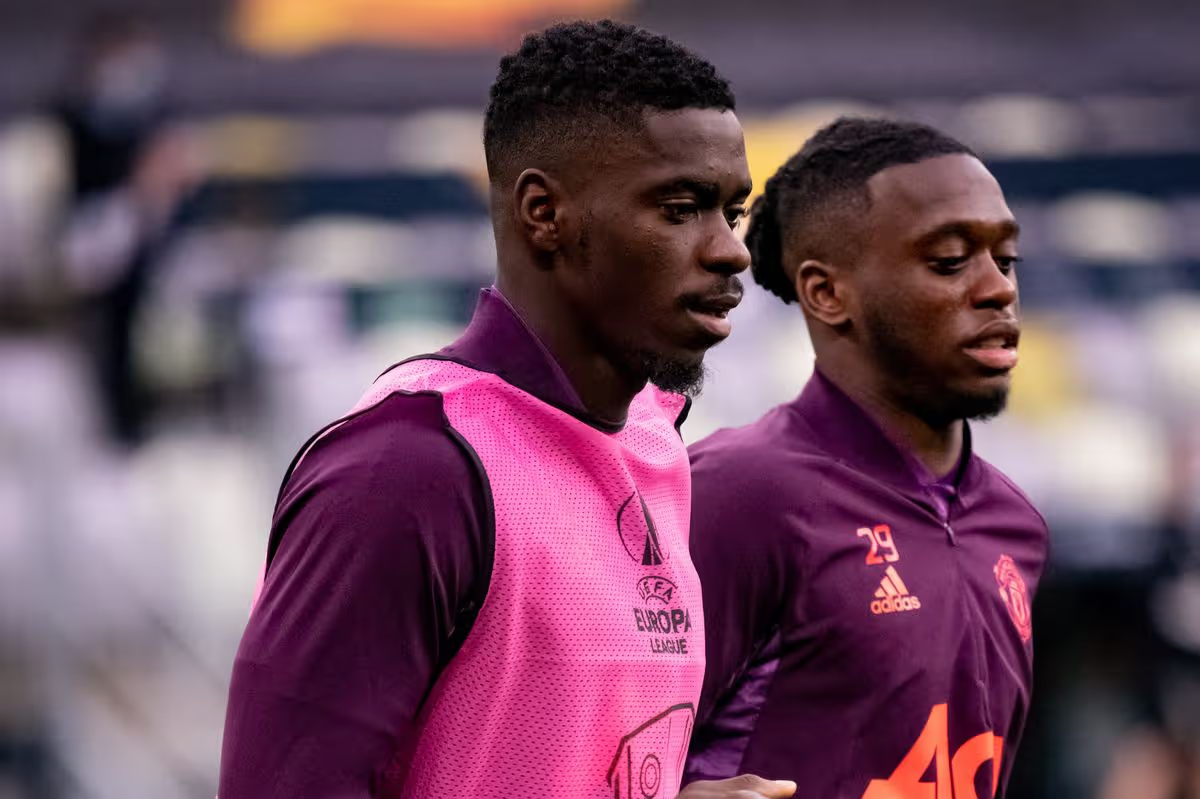
Two names have sat at the centre of the eligibility debate: Aaron Wan-Bissaka and Axel Tuanzebe.
Both players are deeply familiar to English football audiences. Wan-Bissaka, a right-back who made his name at Crystal Palace and later Manchester United before moving to West Ham, was born in Croydon to Congolese parents. He represented England at the under-20 and under-21 levels before eventually declaring for DR Congo and making his international switch.
Tuanzebe, meanwhile, was born in Bunia in the Democratic Republic of Congo but moved to England as a four-year-old. He too came through the England youth setup, representing at under-19, under-20 and under-21 levels, before committing to the Congolese national team in 2024, currently at Burnley.
The NFF argues that although FIFA cleared the players, the information provided by the Congolese federation may have been misleading. The crux of Nigeria’s case rests on something that sounds straightforward but becomes complicated quickly. Congolese law requires renunciation of other nationalities to be eligible, a step Nigeria asserts was not completed.
The logic the NFF is working with goes something like this: both Wan-Bissaka and Tuanzebe hold British citizenship. DR Congo, under its own domestic law, does not recognise dual nationality. Therefore, players who retain a foreign passport are, in theory, not legally Congolese citizens. And if they are not legally Congolese citizens under their own country’s law, how can they be eligible to represent the Congolese national team?
It is a layered argument, and an interesting one. The core of Nigeria’s legal argument was that DR Congo’s domestic law does not recognise dual citizenship. The NFF contended that since these players held European passports, they were not legal Congolese citizens under local law, thus rendering their FIFA clearance “fraudulent.”
DR Congo and their football federation, FECOFA, have pushed back firmly. The Congolese Football Federation rejected the allegations, accusing Nigeria of attempting to overturn a result they failed to win on the pitch. On social media, they stated that the World Cup must be played with dignity and confidence, not with lawyers’ tricks. FECOFA insisted all players were vetted and approved by FIFA, emphasising that international regulations take precedence over national citizenship laws in matters of eligibility.
And that is where the real tension lies. FIFA operates under its own eligibility framework, one that does not necessarily mirror the domestic laws of any individual nation. For FIFA, eligibility is confirmed if a player holds a passport of the country they represent, without considering conflicts with local laws. This discrepancy highlights ongoing debates on how national rules align with international regulations in a globalised football path, particularly in Africa, where many teams rely on Europe-trained players.
So you have two sets of rules, each pointing in a different direction. And caught between them, a World Cup place.
SEE ALSO | World Cup 2026 in the U.S.: What to Expect and How to Prepare
The Wait, and the Rumours
What has made this situation particularly maddening for Nigerian supporters is the absence of a clear answer from FIFA and the swirl of misinformation that has filled the vacuum.
Nigerian football fans waited anxiously as FIFA prepared to make a crucial ruling on February 16th, over a petition filed by the NFF challenging the eligibility of players fielded by DR Congo in the 2026 World Cup African play-off final. That date came and went without a formal verdict.
In the weeks that followed, reports began circulating on social media and then on some news platforms that FIFA had already ruled in Nigeria’s favour. The NFF moved quickly to shut those claims down. NFF Director of Communications Ademola Olajire stated, “There is no decision from FIFA at this time. Any claims that a ruling has been made are false.”
Olajire has been consistent on this. He maintained that the federation remains hopeful of a positive verdict, stressing that Nigeria’s qualification hopes are still subject to FIFA’s final decision. “The NFF have not received any formal communication from FIFA whatsoever. No information can be shared with journalists without first coming to the federations involved,” Olajire said.
FIFA confirmed that the matter has been under review, but has not issued a formal timetable on the ruling. And while the world governing body went about its regular business, publishing its CAS and Football Annual Report for 2025, which made no mention of the Nigeria-DR Congo dispute, the two nations and their supporters were left hanging in a state of suspended anxiety.
FIFA’s Actions Suggest a Direction
Then came the signs that suggested, at least from FIFA’s end, which way this was heading.
Nigeria’s hopes of reaching the 2026 FIFA World Cup appeared to be slipping further when FIFA moved forward with preparations for the Intercontinental Play-Off Tournament, with the Democratic Republic of the Congo still listed among the participating teams. The global football governing body confirmed that ticket sales for the tournament had officially opened.
And then, more definitively: FIFA confirmed the final line-up for the inter-confederation play-off tournament, naming DR Congo as Africa’s representative, with the governing body stating, “All of the six teams have now been decided, with Bolivia, Congo DR, Iraq, Jamaica, New Caledonia and Suriname confirmed as qualifiers.”
The play-off competition will take place from March 26 to March 31, 2026, in Guadalajara and Monterrey, Mexico. According to FIFA, DR Congo will go directly into a final clash against the winner of Jamaica versus New Caledonia, with a place at the 2026 tournament at stake.
For many observers, that confirmation was essentially the ruling. If FIFA were genuinely entertaining the possibility of removing DR Congo from the tournament, they would not be issuing accreditation notices to journalists and selling tickets to games that included them. The practical logic of the situation, in other words, had started speaking louder than the legal process.
Still, the NFF have not backed down. Olajire insisted that the NFF will be the first to know any decision and not the media, and confirmed their wait was still ongoing.
By including DR Congo in the official tournament line-up circulated to global media, FIFA signalled that its disciplinary committee found no merit in Nigeria’s claims to disqualify the Congolese.
SEE ALSO | Where to Buy FIFA World Cup 2026 Tickets and What They Cost
The Sporting Debate Behind the Legal One

Alongside the procedural question, there is a deeper conversation happening, one about fairness, about what it means to earn something, and about where the boundaries of the game really lie.
Many Nigerian fans have thrown their full weight behind the NFF’s petition. For them, if the rules were broken, there is a legitimate case to answer. Rules exist precisely so they can be challenged when they appear to have been violated.
The fact that the defeat came on penalties, that fine margin between going through and going out, only makes it feel more urgent. One save, one different kick, and none of this would have mattered.
There is another school of thought among Nigerian supporters themselves, one willing to admit that going through this way would feel hollow. The Super Eagles had their chance to qualify on the pitch. They played the game, and DR Congo were the better penalty takers on the night.
Winning a World Cup place in a lawyer’s office rather than a football stadium carries a different kind of weight. A complicated one.
That tension is real, and it reflects something broader about where sport sits in relation to law. Football has always had its regulatory disputes, eligibility cases, transfer appeals, and doping hearings, but there is always an instinct among fans to want these things settled between the white lines.
This conflict exposes persistent tensions in African football, where local laws, dual nationality, and the integration of diaspora players often clash with global regulations. The dispute raises a critical question: to what extent can bureaucracy and legality influence football’s passion and results?
Africa, with its wealth of talent and Europe-based elite players, continues to face dilemmas where politics, law, and sport intersect long before the first whistle of the World Cup.
What It Would Mean for Nigeria
The weight of this dispute is inseparable from the context it sits in. Nigeria have been one of the most recognisable presences in African football for decades.
They were at the 2018 World Cup in Russia. They were not at the 2022 tournament in Qatar. Missing a second consecutive edition of the World Cup would deepen a sense that something is structurally wrong with the programme, that there are issues in the system that go beyond individual matches and individual penalty shootouts.
More than 80 per cent of the current Super Eagles squad may never feature in a World Cup before their careers end. Aside from Captain Wilfred Ndidi, Alex Iwobi, and Chidozie Awaziem, none of the current players in the Super Eagles set-up has featured in the Mundial. Most of them may no longer be playing at the World Cup level for the next edition of the competition in 2030 due to age or other variables in the game.
That is a sobering thought. For some of these players, this was the shot. The 2026 tournament, with its expanded 48-team format designed in part to give more nations a pathway, was supposed to represent a new era of accessibility. The fact that Nigeria still cannot get through only sharpens the pain.
The winner of the intercontinental play-off; should DR Congo advance, would join World Cup Group K alongside Portugal, Uzbekistan and Colombia. That is a serious group. A difficult draw.
But the prospect of it, the idea of the Super Eagles having a chance to go and face those teams on the world’s biggest stage, has fuelled everything that the NFF have done since December.
SEE ALSO | Does The FIFA World Cup Have A Halftime Show?
Where Things Stand
Right now, the situation is this: FIFA has, through its actions if not through a formal written ruling, indicated that DR Congo will play in Mexico. The accreditation notices are out. The tickets are sold. The bracket is set. DR Congo face the winner of Jamaica and New Caledonia on March 31st for a place at the World Cup.
For Nigerian fans, the technical details offer little comfort. With no official timeline given for a ruling and no mention of the petition in FIFA’s latest publications, uncertainty continues to dominate discussions around the Super Eagles’ World Cup fate.
Whether a formal FIFA verdict still comes before those games kick off, or whether the NFF pursues the matter further through CAS, the Court of Arbitration for Sport, remains to be seen. The federation has shown no sign of walking away from the complaint, even as the window for it to change anything narrows by the day.
The disqualification has reignited discussions about the need for structural reforms within the NFF and the broader football ecosystem. Those conversations will continue regardless of how this particular case concludes.
For now, Nigeria wait.
Their Super Eagles are not in Mexico. The legal fight is still technically alive, even if the practical odds of it changing the outcome have grown long. The 2026 World Cup will, in all likelihood, proceed without them.
The fact that Nigerians are still talking, still hoping, still refreshing their phones waiting for an official communication; that speaks volumes.
Football does this. It keeps you believing long past the point when the sensible thing would be to let go. The Super Eagles lost in November. The case may effectively be lost now, too. And yet here everyone still is, watching, waiting, and refusing to accept that it is over.


