


Football is a game that runs on memory. The crest on the shirt, the name on the stadium, the chant that rises from the terraces on a winter afternoon, all of it feels permanent, carved into the culture like something that could never have been otherwise.
However, the truth buried beneath these familiar identities is far stranger and more interesting. Most of the clubs we consider to be eternal institutions were born under completely different names, in circumstances that had nothing to do with football as we know it today.
They were created by railway workers, church congregations, munitions laborers, and Basque students. They played in public parks. They wore borrowed kits. They argued about what to call themselves over cups of tea.
The names we use now came later, often born out of crisis. Financial collapse, political upheaval, war, city-wide reorganizations; these are the moments that forced clubs to shed one identity and pick up another. In some cases, the old name vanished completely.
In others, it left traces that fans still carry today without fully knowing why. The story of football’s biggest clubs is also, in a quieter way, the story of names that did not survive.
1. Manchester United
- Formerly: Newton Heath LYR F.C.
The biggest club in England was born inside a railway yard. In 1878, workers from the Carriage and Wagon department of the Lancashire and Yorkshire Railway formed a football team in Newton Heath, a gritty corner of East Manchester that smelled permanently of coal smoke and engine grease.
They called themselves Newton Heath LYR, the letters standing for Lancashire and Yorkshire Railway, and they played in green and gold, colors that modern-day supporters still wear as a subtle act of remembrance, a thread stitched back to those workshops on Northampton Road.
For the first two decades, the club existed in a state of low-level chaos. They moved grounds twice, fell out with the railway company over funding, dropped the “LYR” suffix when they went independent, and spent the 1890s lurching between leagues without ever finding solid ground. By the turn of the century, they were in serious financial trouble, carrying debts of over £2,500; an enormous sum at the time and staring down the very real possibility of going under completely.
What saved them was a dog. According to one of the most repeated stories in football history, a St. Bernard belonging to the club captain went missing during a fundraising bazaar in 1901. The dog was found by John Henry Davies, a local brewery owner who was wealthy, well-connected, and apparently fond of strays in more than one sense of the word. Davies ended up buying into the club, cleared the debts, and immediately set about remaking Newton Heath into something more presentable.
They considered Manchester Central. They considered Manchester Celtic. In the end, they settled on Manchester United and in doing so, chose a name that would one day become the most commercially recognizable in the sport.
The green and gold were swapped for red and white. The name went to a vote among committee members, and the options ranged from the dull to the uninspired.
They considered Manchester Central. They considered Manchester Celtic. In the end they settled on Manchester United and, in doing so, chose a name that would one day become the most commercially recognizable in the sport.
That transformation, from a railwayman’s kickabout team to the club now worth billions, started with a lost dog and a brewer who thought a rebrand might shift a few more pints.
SEE ALSO | 10 Greatest Hat-tricks In Champions League History
2. Arsenal
- Formerly: Dial Square F.C.
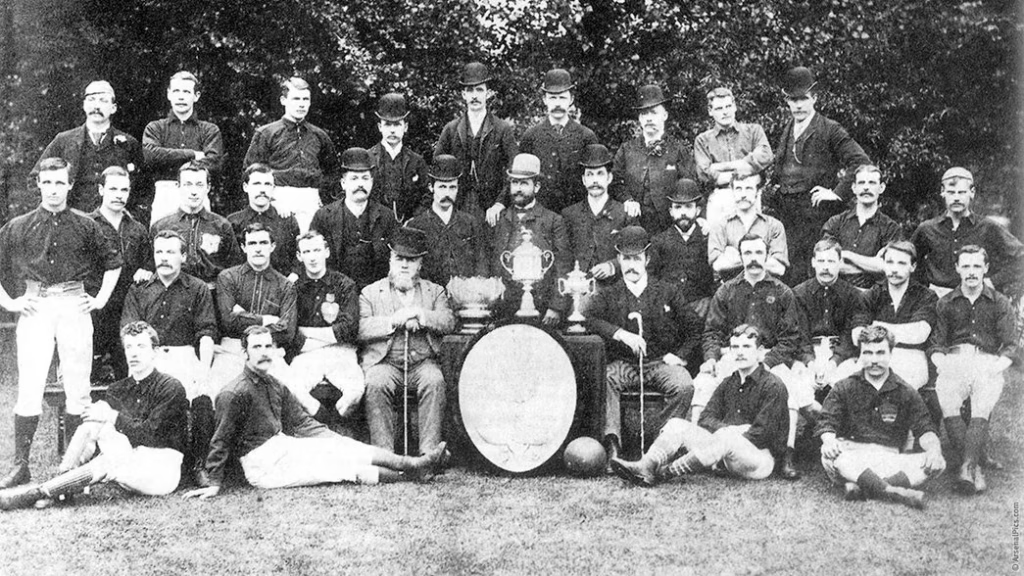
The origin of Arsenal is buried in gunpowder and industrial metal. In 1886, workers at the Royal Arsenal complex in Woolwich, a huge munitions facility on the south bank of the Thames, formed a football team.
They named it after the workshop at the physical center of the factory: a building called Dial Square, distinguished by a large sundial mounted on its roof. It was a name that meant something to the men who worked there, who knew exactly which part of that sprawling operation they called home.
Within months, they had outgrown it. They changed the name to Royal Arsenal, wanting something that sounded slightly more imposing, slightly less like a lunch break activity.
As they professionalized, they became Woolwich Arsenal; the “Woolwich” prefix anchoring them to their South London home, where they had built a genuine fanbase from the working-class communities around the factory.
The decisive break came in 1913, and it was deeply controversial. The club’s directors decided to move the operation across the river to Highbury in North London, chasing bigger crowds and better infrastructure. South London felt abandoned. The fans who had built Woolwich Arsenal’s early support were suddenly watching their club relocate to enemy territory.
To mark the fresh start, the Woolwich prefix was dropped entirely, leaving just Arsenal, a word that pointed back to the cannons and the factory without tying the club to any particular postcode.
The cannon on the crest is the permanent echo of all of this. Every time Arsenal takes the field, the badge on their shirts carries the outline of an artillery piece, a direct descendant of the munitions factory where a group of workers decided, one afternoon in 1886, that they wanted to play football.
3. Manchester City
- Formerly: St. Mark’s West Gorton

Long before Abu Dhabi money and the Etihad Stadium, Manchester City were a church team trying to keep young men out of trouble. St. Mark’s West Gorton was founded in 1880 in one of the toughest and most impoverished corners of East Manchester.
The driving forces behind it were the rector’s daughter, Anna Connell, and two church wardens who believed that organized sport could give local men something constructive to do on their weekends instead of drinking themselves into fights.
They were almost certainly right, and the team grew quickly. By 1887, they had moved to a new ground and relaunched as Ardwick AFC, shedding the religious association to attract players and supporters who had no particular connection to the church. For a few years, Ardwick was a reasonable local outfit, competing in the Football Alliance and making modest progress.
Then the money ran out.
The early 1890s hit them hard. Financial mismanagement and falling attendances left the club in no position to continue operating in its existing form. In 1894, Ardwick was effectively dissolved and rebuilt from scratch under a new name and a new organizational structure.
The name they chose was Manchester City, and the reasoning was deliberate. This was no longer a team representing one parish or one corner of East Manchester. This was a club for the whole city, an institution that could sit alongside Manchester United and define a rivalry that would grow for the next century and beyond.
The local derby that followed between a club born in a church and a club born in a railway yard would become one of the defining fixtures in English football. Neither side started anywhere near where they ended up. That gap between origin and destination is most of what makes their rivalry feel the way it does.
SEE ALSO | Top Most Assists in a Premier League Season
4. AC Milan
- Formerly: Milan Foot-Ball and Cricket Club

There is something stubborn about AC Milan insisting, to this day, on the English spelling of their city’s name. Every other major Italian club writes theirs in Italian.
Milan — not Milano — sits on the crest like a small act of defiance, and the explanation for it goes all the way back to the club’s founding in 1899 by an English expatriate named Herbert Kilpin.
Kilpin was a lace trader from Nottingham who had fallen in love with Italy and with football in roughly equal measure. He and a group of fellow British expatriates formed the Milan Foot-Ball and Cricket Club, a name that reflected both sports they intended to play and the cultural world they came from.
The English spelling was just what they used because English was the language in which the club was conceived. The hyphen, the cricket, the full formal construction; all of it announced that this was a British enterprise transplanted to northern Italy.
Mussolini’s regime decided, in the late 1930s, that an Italian football club should not carry a foreign-sounding name. So, Milan Foot-Ball and Cricket Club was forced to become Associazione Calcio Milano.
It stayed that way until the politics of the 1930s intervened. Mussolini’s fascist regime had strong opinions about what Italian institutions should be called, and a football club with English words in its name was exactly the kind of thing that made the authorities uncomfortable.
The club was forced to rebrand as Associazione Calcio Milano, Italian through and through, with the city’s Italian spelling restored. The name was an imposition, worn without particular enthusiasm.
When the war ended and the regime collapsed, Milan reverted almost immediately. They kept the “AC” = Associazione Calcio as a holdover from the fascist-era naming, but put “Milan” back in the English spelling.
It has remained that way ever since. Seven European Cups later, the team that Kilpin built is still carrying his spelling on the badge. It is one of the stranger linguistic survivals in world football.
5. West Ham United
- Formerly: Thames Ironworks F.C.

The story of West Ham United is inseparable from the smell of the river. Thames Ironworks was founded in 1895 as a works team for the Thames Ironworks and Shipbuilding Company, one of the largest employers on the north bank of the Thames in East London.
The men who played for it were shipbuilders, boilermakers, riveters, workers who spent their weeks constructing the vessels that would sail out to the empire and back.
Football was what they did on Saturdays.
The club was known as the Irons from the very beginning, and the name stuck in the way that authentically earned nicknames always do. These were men who worked with iron every day. The connection was not decorative.
When the Thames Ironworks company finally disbanded the football operation in 1900, the workers behind the club reformed it independently under the name West Ham United; a broader geographical identity designed to draw in supporters from across the East End rather than just from one workplace.
The company name disappeared. The tools of the trade did not. The two crossed hammers on West Ham’s crest are a direct image of the shipbuilding origins, the tools of the men who founded the club, preserved and passed down through every era of the team’s history.
Even after the move from Upton Park to the London Stadium, even after the noise of the new home and the debates it generated, those hammers remained on the shirt. It is one of the most honest badges in English football: a picture of what the people who built the club actually did for a living.
SEE ALSO | How to Train in Cold Conditions: 20 Practical Tips That Work
6. Everton
- Formerly: St. Domingo F.C.

Everton Football Club is one of the oldest in the country, but for their first year of existence, they were a congregation’s cricket and football team in disguise. St. Domingo’s was formed in 1878 under the auspices of St. Domingo Methodist Chapel in the Everton district of Liverpool.
The original idea was simple: give the men of the congregation a sport to play during the winter months, when cricket season was over and the evenings were long.
The team was good enough and popular enough that word spread beyond the chapel walls. Players from outside the parish started showing up, wanting to join. The committee faced a choice: keep the club small and parochial, or open it up.
They opened it up. And the moment they decided to welcome players with no connection to St. Domingo’s, the name became a problem. It no longer described the people playing.
In 1879, barely a year after founding, they renamed themselves Everton, after the neighborhood that contained them. It was a straightforward, functional decision, but the timing gave it unusual weight. Everton was about to become a founding member of the Football League in 1888, which meant the new name was baked into the sport’s founding documents from the very beginning.
Every reference to that first-ever Football League season carries the name, Everton. The chapel that started it all has been forgotten by most, but the neighborhood it sat in has been written into football’s permanent record.
7. Paris Saint-Germain
- Formerly: Stade Saint-Germain
PSG is the youngest club on this list and the most deliberately constructed. While the English clubs evolved organically over decades, Paris Saint-Germain was put together in a boardroom in 1970 by a group of businessmen who had identified a problem and decided to solve it commercially.
The problem was that Paris, the capital of France, one of the great cities of the world, had no major football club worth the name.
The city had lost Racing Club de Paris to financial collapse. The teams that remained were scattered across the suburbs, too small to compete with the likes of Marseille and Saint-Étienne at the national level.
The solution the businessmen arrived at was a merger: take the existing Stade Saint-Germain, a modest club from the affluent western suburb of Saint-Germain-en-Laye, and combine it with a newly created entity called Paris FC, which brought fresh money and the connection to the capital itself.
The resulting club was named Paris Saint-Germain, blending the city with the suburb in a name that tried to be both metropolitan and locally grounded at the same time. The arrangement did not last in its original form; Paris FC broke away again within a few years, preferring to operate independently.
But PSG kept the name and kept building, eventually becoming the dominant force in French football through a combination of ambition, geography, and the kind of sovereign wealth investment that would have been unimaginable to the businessmen who founded them in 1970.
The name they settled on that year remains the one sewn onto shirts in the Parc des Princes half a century later, worn by players who cost more than some entire football leagues.
SEE ALSO | Salah and Liverpool: The Real Reasons Behind the Shock Split
8. Newcastle United
- Formerly: Newcastle East End
Newcastle’s story is, at its core, a story about a divided city becoming whole. In the late Victorian era, the city had two major clubs: Newcastle East End and Newcastle West End. They played on opposite sides of the city, drew support from opposite communities, and competed directly for the same limited pool of players and spectators that a city of that size could support.
Neither was strong enough to sustain itself properly. Both were scraping along.
West End collapsed first. By 1892, the financial pressure had become insurmountable, and the club folded. East End, who had been the stronger outfit for some time, stepped in and took over West End’s lease at St. James’ Park, the ground that sat on a hill above the city center.
It was a practical decision driven by the fact that St. James’ was a better stadium than anything East End had previously called home.
The new name was a declaration of civic unity. Newcastle United, not Newcastle East, not Newcastle North, not any other directional qualifier, but United.
One club, one city.
With the new ground came a new name. The directors of the newly reconstituted club chose to drop the “East End” designation entirely, recognizing that they were now claiming to represent the whole city, not just one half of it.
Newcastle United was the result, a declaration of civic unity that the name itself announces every time it is written down. Not Newcastle East, not any directional qualifier, but United.
The same word Manchester picked in 1902, the same word West Ham embedded in their relaunch in 1900. In Victorian football, United was the word you chose when you were trying to say that the old divisions were finished.
The ground they took over from the West End has never changed. St. James’ Park remains exactly where it was in 1892, and Newcastle United are still playing in it, which makes their claim to continuity unusually strong. The name changed, but the hill it sat on did not.
9. Atlético Madrid
- Formerly: Athletic Club Sucursal de Madrid

Atlético Madrid began their existence as, essentially, an extension of another club. In 1903, three Basque students who were studying in Madrid founded a football team to fill the gap they felt living away from home in a city that had no meaningful football culture yet.
They called the club Athletic Club Sucursal de Madrid; the Sucursal meaning branch, in the sense of a branch office. They were, by their own framing, just an outpost of Athletic Club Bilbao, the great Basque institution they had left behind when they moved south for their studies.
They played in the same blue and white vertical stripes as Bilbao. They used Bilbao’s organizational structure as a template. The club was not trying to be independent; it was trying to maintain a connection to home. Over time, as the Madrid operation grew and developed its own players, its own supporters, and its own identity, the fiction of being a branch office became harder to maintain.
The Madrid club wanted to stand on its own terms.
A series of name changes followed. During the Spanish Civil War and its aftermath, the club merged with the Spanish Air Force team and became Athletic Aviación for a period, one of the more unusual names in the history of a major European club, reflecting the militarized politics of Franco’s Spain.
When that partnership eventually dissolved and Spanish football normalized, the club finally settled on Atlético de Madrid in 1947, using the Spanish spelling rather than the Basque “Athletic,” marking themselves as a genuinely Madrileño institution rather than an outpost of anything.
The red and white stripes came from a different source entirely, local lore says a shipment of Sunderland shirts arrived in Madrid in the early days when the club could not afford its own kit, and they have worn them ever since, entirely their own now, nothing remaining of the Bilbao connection except the history that underpins it.
SEE ALSO | 10 Most Shocking Managerial Appointments in History
10. Leicester City
- Formerly: Leicester Fosse F.C.

The last name change on this list is also, in some ways, the most typically English. Leicester Fosse was formed in 1884, taking their name from Fosse Road; a long, straight road running through Leicester that follows the line of the old Roman road, the Fosse Way.
They played nearby, and the name was the most straightforward thing imaginable: the team from that part of town, on that road.
The nickname “The Fossils” followed almost immediately, used both affectionately by fans and slightly less affectionately by rival supporters. For thirty-odd years, Leicester Fosse stumbled along as a second-tier English club, occasionally threatening to break through to the top division and consistently finding ways not to quite manage it.
They were not terrible.
They were not memorable.
They were Leicester Fosse.
The First World War effectively suspended organized football, and when the sport reconvened in 1919, the club needed to be restructured. Debts had accumulated, the old organization was dissolved, and a new one was assembled in its place. And at precisely this moment, the borough of Leicester was granted city status by the Crown, a formal recognition that the place had grown into something more significant than a market town.
The club directors seized on this.
If Leicester were now a city, then the football club should reflect that. Leicester Fosse became Leicester City, a name that exchanged the local street reference for a civic declaration.
The Fossils’ nickname faded, The Foxes eventually replaced it, and the club built by those Victorian lads near Fosse Road went on, almost a century later, to win the Premier League title in the most improbable fashion the English game had ever seen.
The Roman road that gave them their original name had nothing to do with any of that. But without it, there might never have been a club at all.
SEE ALSO | 10 of the Biggest Fights in Football History
Final Thoughts
Every name change in this list was a response to something. A bankruptcy. A merger. A war. A political regime. A city growing larger than one neighborhood could contain. None of these clubs sat down one afternoon and decided to change their names for branding purposes. The changes came from outside, pressed on them by circumstances that left little room for sentiment.
What survived in each case was something more durable than a name, a community of people who kept turning up regardless.
Football supporters have a phrase for this that they use without thinking about it: the club is the club. What they mean is that the institution transcends any particular version of itself; the name, the stadium, the players, the owners. It is the accumulated weight of everyone who ever stood in the cold and watched and cared. The names that appear on the shirts today are the names that survived.
Behind each of them is another name that didn’t, and a story about why it had to change.
Those older names are worth knowing. They are the foundation under the foundation, the thing before the thing that became what it is now.


