

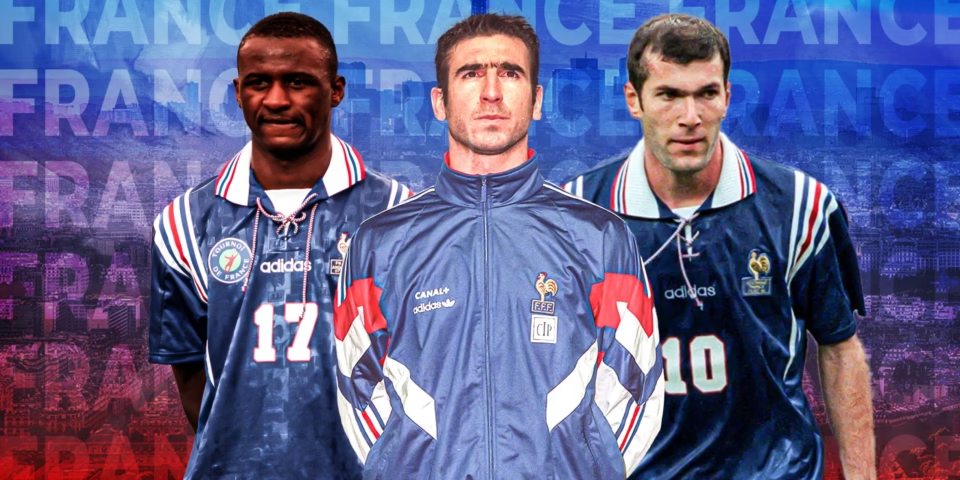
French football has always existed somewhere between pragmatism and artistry, between the grit of a nation that builds its champions in the banlieues and the breathtaking technical beauty that has made the game feel like something closer to culture than sport.
The list that follows is not a catalogue of trophies, though there are plenty of those scattered throughout these profiles. It is an attempt to understand the players who most completely embodied what it means to pull on the Les Bleus shirt that carries the weight of an entire republic’s expectations, and then somehow exceed every single one of them.
The debate over who deserves to be here and who has been unfairly excluded will go on long after this article has been read, and that is as it should be, because French football has produced an embarrassment of riches across nearly a century of competition.
What we can say with certainty is that the 10 players who appear on this list each changed the game in some meaningful and lasting way, and that the history of international football cannot be told honestly without their names appearing near the very top of the conversation.
10. Karim Benzema
- 2007 – 2023 · 97 caps · 37 goals
There is a smooth irony embedded in the story of Karim Benzema that makes it impossible to tell cleanly, because one of the most naturally gifted strikers to emerge from the Lyon academy spent much of his international prime in the wilderness before returning to claim his rightful place among the very best this sport has ever seen.
He was never a goalscorer in the traditional, penalty-box-haunting sense because he operated with the spatial awareness of a playmaker and the finishing touch of someone who had been doing this since childhood, drifting into wide areas to create space for teammates while never losing that lethal edge when the ball dropped to him in dangerous positions.

His journey toward winning the 2022 Ballon d’Or was as much a story about longevity and adaptation as it was about raw ability, demonstrating over more than 15 years of professional football that he could lead the line for the biggest club in the world while remaining a deeply selfless teammate who valued the collective rhythm above any individual statistic.
The years away from the national squad hurt him, and perhaps cost France a tournament or two. When he eventually returned, the performances he delivered confirmed that the talent had never dimmed even slightly.
His collection of European titles at Real Madrid and his sheer consistency in the world’s best league make any serious conversation about this list incomplete without his presence, whatever the complexities of his relationship with Les Bleus have been along the way.
SEE ALSO | 10 Greatest Attacking Trios In Football
9. Patrick Vieira
- 1997 – 2009 · 107 caps · 6 goals
If you were to sit down and design the ideal modern midfielder from scratch, working through every quality you would need to dominate at the highest level, you would likely end up producing something that looked and moved and competed exactly like Patrick Vieira during his dominant physical peak at the turn of the millennium.
He was a towering, commanding presence who could break up opposition attacks with a single telescoping stride and then immediately transition into a surging driving run that left defenders reaching for something that had already passed them by as he advanced toward the edge of the box with genuine menace.
“He possessed a rare ability to dictate the temperature of a match through sheer force of will, which is perhaps the rarest quality any footballer can carry.”

His partnership with Emmanuel Petit provided the iron spine that allowed the creative forces of the 1998 and 2000 squads to express themselves freely, Vieira himself was far more than just an enforcer or a destroyer because his passing range and tactical intelligence were frequently underplayed in favour of his combative reputation.
The fact that he captained Arsenal to an entire Premier League season without a single defeat tells you everything you need to know about the kind of relentless winner he was, and France owed much of their tournament success during those golden years to the control he exerted over the midfield spaces that other teams assumed they could exploit.
8. Marcel Desailly
- 1993 – 2004 · 116 caps · 3 goals
They did not call him “The Rock” as a casual nickname or a piece of throwaway flattery, because Marcel Desailly genuinely felt like an immovable and uncompromising object whenever he stood at the heart of the French defence during their sustained golden era of dominance in the late nineties and early two thousands.
He was a pioneer of the hybrid defensive role at a time when football was still working out how to classify players who refused to be confined to a single position, moving comfortably between a deep-lying midfield role and the center of a back four while maintaining an extraordinary level of concentration and physical authority that very few forwards in world football were brave enough to challenge directly.

His success at AC Milan and then Chelsea established him as a global brand of defensive excellence with reach beyond any single club or league, but it was his absolute leadership during the 1998 World Cup campaign and the subsequent European Championship triumph two years later that truly cemented his legacy as a winner who simply refused to accept anything less than total perfection from himself and everyone around him.
He read the game with a kind of quiet analytical intelligence that allowed him to intercept passes before the opposition had even processed that a gap existed, and his aerial dominance meant that France was genuinely difficult to break down during the most pressure-laden moments of both those championship runs in ways that the statistics never quite captured fairly.
SEE ALSO | 10 Greatest Fanbases In World Football 2026
7. Lilian Thuram
- 1994 – 2008 · 142 caps · 2 goals
Thuram played the game with the analytical precision of a philosopher and the explosive physical intensity of a sprinter, making the seamless transition between the right side of a back four and the centre of a defensive line look straightforward during a career that was fundamentally defined by its remarkable and unwavering consistency across more than a decade at the top of the European game.
He was widely respected by coaches and opponents alike for his positional intelligence and his uncanny ability to shut down the most dangerous attacking wingers in the world, but he will forever carry a singular and near-mythical association with one particular night in Saint-Denis that changed the course of French football history.
“One hundred and forty-two international appearances. Two goals. Both scored in a World Cup semi-final when his country needed them most.”

During the 1998 World Cup semi-final against Croatia, after a rare positional error had gifted the opposition an equalizing goal and the pressure on France became genuinely suffocating.
He transformed himself into something that none of his teammates or the millions watching at home had ever quite anticipated, scoring twice in rapid succession to propel the hosts into the final and marking the only two goals he would ever record across a staggering one hundred and forty-two international appearances.
The almost mythological nature of that performance encapsulated exactly the kind of person and competitor he was, someone who would shoulder the full weight of his nation’s expectations at the absolute highest-pressure moment and respond not with words or gestures, but with the decisive action that mattered most
6. Just Fontaine
- 1953 – 1960 · 21 caps · 30 goals
The record for the most goals scored across a single World Cup tournament is one of those sporting achievements that grows more extraordinary with each passing decade, acquiring an almost mythological quality as the years accumulate around it.
Fontaine’s thirteen goals across the 1958 edition in Sweden continue to stand as a monument to the kind of predatory finishing instinct that seems to belong to a different register of human performance altogether.
He was a striker who lived for the precise moment the ball entered the final third of the pitch, possessing what appeared to be a supernatural ability to locate the small and fleeting pockets of space that existed between defenders for only a fraction of a second, combined with a shooting accuracy that made every touch inside the box feel like a near-certain consequence.

It is one of the great tragedies of French football, and perhaps of the sport more broadly, that recurring injuries ended his career before he had reached the age of thirty, cutting short a trajectory that his numbers suggest could have produced records that might have stood entirely unchallenged across any era of the game.
30 goals in just twenty-one international appearances is a scoring ratio that most of the great strikers who ever played could not approach even at the height of their powers, and it speaks to the almost absurd efficiency with which Fontaine converted opportunity into achievement.
Even operating within a career that the cruelty of injury kept brutally short, he managed to define an entire generation of French forward play and proved that a Frenchman could compete on completely equal terms with the finest South American attackers on the world’s biggest stage, which was genuinely no small thing to demonstrate in 1958.
SEE ALSO | Greatest Player in Every Premier League Club’s History
5. Kylian Mbappé
- 2017 – Present · 80+ caps · 50+ goals
There is something almost frightening about considering what Mbappé has already accumulated in this sport, given that he is, by most reasonable assessments, still approaching the physical peak of his professional career rather than descending from it, and yet the volume and the quality of his achievements already place him comfortably within the conversation about the greatest to ever represent Les Bleus.
From the moment he emerged as a teenager at Monaco, playing with the kind of fearless directness that seemed to ignore the weight of expectation entirely.
He has operated at a speed that appears to challenge the ordinary assumptions about what a footballer’s body can produce, combining that raw and astonishing acceleration with a finishing ability that is remarkably composed for a player operating under the kind of global scrutiny that would destabilise most athletes.
“He dragged France back into a World Cup final with a hat-trick. He was twenty-three years old. The argument for where his ceiling sits has not yet begun.”

His performance during the 2022 World Cup final in Qatar, where he single-handedly dragged his country back from what appeared to be a comfortable defeat with a historic hat-trick against Argentina that sent the match spiralling into extra time, was the kind of definitive statement that only elite players can make under that particular kind of pressure when the entire sporting world is watching every movement.
He plays with a joy that feels authentic and unforced, a relentless desire to attack and run and create that makes him the most genuinely box-office talent the game has produced in the current era.
And the sense that his most significant contributions to the sport are still arriving rather than receding makes ranking him anything lower than the top three feel like a position that may well need revisiting within the next five years of an already extraordinary career.
4. Raymond Kopa
- 1952 – 1962 · 45 caps · 18 goals
Long before the era of satellite television and global football branding had made it possible for a player’s reputation to travel faster than the highlights packages, Kopa was already the first genuine superstar that French football had produced.
A diminutive and explosively gifted inside forward known throughout Europe as the “Little Napoleon” whose dribbling ability could reduce entire stadiums to a state of collective disbelief in the way that only a handful of players across any era of the sport have managed to achieve.
He carried himself with a technical confidence that belonged to someone who had developed his relationship with the ball long before any coaching structure could interfere with it, and the result was a style of play that felt completely natural and completely untameable in equal measure.

He was the creative heartbeat of the celebrated Reims side that lit up French football throughout the fifties, and then became a vital and influential component of the Real Madrid team that claimed three consecutive European Cups, proving beyond any reasonable doubt that French technical ability could flourish under the most demanding conditions and against the most formidable competition that European club football could assemble.
Kopa saw passing lanes that his contemporaries simply could not perceive, and his partnership with Just Fontaine during the 1958 World Cup provided what amounted to the first real blueprint for the attacking flair that would eventually become so firmly embedded in French footballing identity that it felt almost inevitable.
Winning the Ballon d’Or that same year confirmed what anyone who had watched him play already knew, and his influence on every creative Frenchman who subsequently wore the number ten shirt stretches far further than the silverware alone could ever capture.
SEE ALSO | 20 Greatest African Footballers of the 21st Century
3. Thierry Henry
- 1997 – 2010 · 123 caps · 51 goals
Henry did not score goals at the rate and with the consistency that he did, he scored them with a level of elegance and predatory intelligence that made the genuinely difficult task of navigating a Premier League defense look like an entirely choreographed exercise in controlled beauty, as though the entire sequence had been planned and rehearsed somewhere quiet before being performed for the audience that had gathered to watch.
His transition from a struggling wide player in Italy to the most feared attacking force in world football under the patient and visionary guidance of Arsène Wenger at Arsenal is one of those football stories that gets better every time it is told.
However, it was his sustained excellence in a French shirt across an international career spanning thirteen years that really consolidated his status as a genuinely global sporting icon rather than simply a brilliant club player.

He possessed a unique galloping stride that allowed him to pull clear of the quickest defenders in the world every week, he always carried with him the technical presence of mind to open his body at the last possible moment and curl the ball into the far corner of the net with a trademark left-footed finish that became one of the defining images of a decade of Premier League football.
He retired as the all-time leading scorer in French international history at the point of his departure, having won both the World Cup and the European Championship to confirm that he was as effective in tournament football under the greatest possible pressure as he was across the long stretch of a domestic season.
His influence on the culture of the game reaches considerably further than the goals he scored, because he remains the most complete example of what a modern versatile forward can be; quick and powerful enough to beat defenders in open space, intelligent enough to operate in congested areas, and technically refined enough to make the hardest things look completely effortless.
2. Michel Platini
- 1976 – 1987 · 72 caps · 41 goals
Across a stretch of the mid-1980s that now occupies a special place in the memory of anyone fortunate enough to follow football during that era.
Platini was the most complete and the most technically assured footballer on the planet, a playmaker who combined the long-range vision of a grandmaster with a goalscoring record that most frontline strikers operating in the same period would have been deeply envious of.
Even though he was producing all of this from a position in the centre of midfield rather than anywhere near the penalty box. He was the player that opponents tried to plan around and neutralise before a match began, which is perhaps the most honest compliment that professional football can pay to any individual talent.
“Nine goals in five matches at a single European Championship, while playing as a number ten. The most devastating individual performance a major international tournament has ever witnessed.”

His performance during the 1984 European Championship held on home soil remains, by the reckoning of many serious students of the game, the greatest individual display that any player has produced across the entire recorded history of major international tournament football.
Nine goals in just five matches to lead France to their first piece of major silverware, executing it all with a composure and a technical quality that suggested he was operating slightly outside the normal constraints of what the game demanded.
Platini was a specialist in the art of the dead-ball situation and a master of the weighted through-pass, consistently finding teammates with a precision that appeared to entirely ignore the presence of opposition defenders between the ball and its intended destination.
Three consecutive Ballon d’Or wins during an era of genuinely brutal physical competition across European football confirms that this was not a case of great timing or fortunate circumstances, but of a player so far ahead of his peers that the award became almost automatic.
He remains the spiritual godfather of the intelligent and stylish brand of football that every subsequent generation of French players has been expected to aspire toward.
SEE ALSO | The 10 Greatest African Football Players to Ever Play for Real Madrid
1. Zinedine Zidane
- 1994 – 2006 · 108 caps · 31 goals
Some footballers win matches and change results, and then there are players like Zizou, who appeared to exist on an entirely different plane of reality from everyone else on the pitch. A place where the ball was just an extension of his own body and where the noise and the chaos of a World Cup match were nothing more than an atmospheric backdrop for whatever piece of magic he was preparing to produce next.
No player in the history of the French national team, and arguably in the broader history of the sport itself, has ever combined the physical presence of a genuine athlete with the technical refinement of a pure artist so completely and so convincingly as Zidane did across a professional career that spanned from Cannes to Real Madrid and back again.
“His face was projected onto the Arc de Triomphe. That is the category of footballer Zinedine Zidane belonged to. Not a player — a national experience.”

His performance in the 1998 World Cup final at the Stade de France, where he rose above the Brazillian defense to head home twice before half-time and deliver the trophy that a nation had been dreaming about since football was invented, transformed him almost overnight from an extraordinarily gifted footballer into something that French culture had no established category for.
A figure of near-mythological status whose image was projected onto the façade of the Arc de Triomphe as millions of people flooded the Champs-Élysées in a state of collective and disbelieving joy.
The idea that this happened because of a footballer, even one as extraordinary as Zidane, gives you some sense of how completely he occupied the imagination of the entire republic during those years and how fully the weight of expectation rested on his particular set of shoulders.
He possessed a physical grace that seemed almost impossible to reconcile with the size and the strength of his frame, deploying his famous Zidane pirouette and a series of delicate, feather-light first touches to escape the most intense and committed defensive pressure in ways that left both spectators and opposing players in a state of genuine, open-mouthed disbelief.
The roulette was not simply a trick or a piece of crowd-pleasing showmanship.
It was a functional and devastatingly effective solution to a defensive problem, executed with a casual authority that suggested it was always the most obvious option available to him rather than something requiring any particular effort or concentration.
His career ended in a manner as dramatic and as layered with meaning as any significant piece of literature, the headbutt in the final of the 2006 World Cup remains one of the most debated and most reinterpreted incidents in the history of sport, a moment that sum up the complexity of a man who carried his passion and his pride so close to the surface that the greatest stage could not contain the full force of what he felt.


