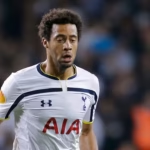
Richard Rufus was everything Charlton Athletic fans could have wanted. A Lewisham lad, born a few miles from The Valley, who grew up to anchor their defense for over a decade. The big clubs came calling but he stayed put, and when things got difficult he stayed put again. One-club men are vanishing from football; he seemed like the real thing.
Except his story has nothing to do with last-ditch tackles or promotion glory.
What happened after he stopped playing is darker than anything that happened on the pitch. He took the trust he had built over the years and weaponized it against the people who loved him. This was no string of bad investments or unfortunate property deals, rather a calculated £15 million pyramid scheme that destroyed his church, devastated his family, and gutted his closest friends.
The Heights Before the Fall

You need to understand what he was before you can understand what he became. Rufus joined Charlton as a teenager in the early 1990s, and by 1994, he was playing first-team football with a maturity that belied his age.
Quick, strong, and intelligent, he read the game like he had seen it all before.
The numbers tell some of the story: 28 appearances in his debut season, then 41 the next as he became a fixture in the backline. When Charlton finally made it to the Premier League in 1998, Rufus scored the equalizer in that playoff final against Sunderland, a goal without which the club’s modern history looks completely different.
He was a hero in every sense that mattered to supporters. Reliable when others wavered, he was also a born-again Christian who talked about faith and doing right in a sport not known for either.
Alan Curbishley, his manager, once said Rufus was the best player never to wear an England shirt. In a game full of egos and mercenaries, Rufus felt like something else entirely, someone whose authenticity you could bank on.
SEE ALSO | Pitch Invaders in Football: Why They Do It and What Happens Next
When the Body Gives Out
His playing career ended the way careers often do for defenders, with a knee injury that surgery could not fix and rehab could not salvage either. The body had decided it was finished. In 2004, at 29 years old, he retired from professional football with his reputation intact and his legacy secure.
Retirement breaks a lot of athletes because the routine vanishes overnight, and the adrenaline stops flowing just as the money starts running out. Most players slide into coaching or media work, and Rufus did both. He worked as an ambassador for Charlton, coached in their academy, and got inducted into the club’s Hall of Fame in 2013, all the markers of a career well-lived and properly honored.
But while all that was happening publicly, something much worse was taking shape behind closed doors, a deception so complete that it would eventually consume everything he had built.
The Con Begins
Around 2007, he started telling people he had figured out the foreign exchange markets, that he had cracked the code on Forex trading. He claimed he was generating 60% returns with minimal risk, the kind of numbers that should have raised immediate red flags but somehow did not because they were coming from Richard Rufus.
And people believed him because he was a footballer, the Charlton legend who had never put a foot wrong, the man of God who spoke about stewardship and responsibility, the family man who embodied everything they valued.
He went after his inner circle first, targeting friends and family members who would be predisposed to trust him without asking too many difficult questions.
The church part cuts the deepest because he conned his own congregation out of £5 million. These were people who trusted him as more than a neighbor or former footballer, who saw him as a brother in their faith and believed that shared spiritual commitment meant something fundamental about his character.
The truth was uglier than anyone realized at the time. He had no genius for trading and was in fact, losing money at a catastrophic rate. To hide the losses and maintain the illusion of success, he built a classic Ponzi scheme where money from new investors paid the returns for old investors.
The scheme has been around forever because it works brilliantly until it collapses, and it always collapses eventually.
SEE ALSO | Ronaldo Nazário’s Kids and Their Mothers: Everything You Need to Know
The Lifestyle Funded by Lies

While cash poured into his accounts, he was living anything but modestly. He was spending like a man who had earned every penny through his own brilliance rather than someone systematically defrauding the people closest to him.
A five-bedroom house in a gated South London community became his base of operations. A Bentley sat in the driveway while a Rolex gleamed on his wrist. £300,000 went on travel, fine dining, and shopping, all the trappings of success without any of the actual success to justify it.
He looked the part of a successful businessman, and every bit of it was stolen from people who had spent decades building those savings through hard work and sacrifice.
Even the football community got burned in ways that felt particularly cruel. Paul Elliott, who played for Chelsea and Charlton, handed over £425,000 between 2008 and 2011 based on the same promises Rufus was making to everyone else.
Elliott eventually got his money back, but prosecutors later revealed the ugly truth that those returns came from money Rufus had taken from other victims. It was a betrayal that cut deep because Elliott was a fellow professional who should have been safe from this kind of exploitation.
The human cost went far beyond the numbers on any spreadsheet. People lost their life savings, including some who had received insurance payouts after accidents that changed their lives forever, and Rufus took that too.
Friendships that had lasted decades disintegrated overnight while families fractured under the weight of financial ruin and mutual recrimination. The mental damage he inflicted on his victims will outlast any prison sentence he serves.
The Walls Close In

By 2013, the scheme was unraveling in ways Rufus could no longer hide or explain away. He was declared bankrupt after a failed £6 million investment, and in 2015, a civil court judge officially labeled him a fraudster. The criminal justice system took years to catch up, grinding through the evidence and building the case that would eventually bring him to account.
The final reckoning came in January 2023 when, on his 48th birthday, Rufus was sentenced to seven and a half years at Southwark Crown Court. Four counts of fraud, money laundering, and carrying out regulated financial activity without authorization resulted in guilty verdicts across the board.
The judge was blunt about what Rufus had done, describing his actions as a “cynical” betrayal of trust. His defense tried to argue he had operated in good faith, that he genuinely believed the scheme would work, and intended to make everyone whole eventually.
The jury saw through it completely because you just do not spend £300,000 of other people’s money on Bentleys and expensive meals if you think you are helping them build their wealth.
SEE ALSO | The Truth Behind Xabi Alonso’s Sacking at Real Madrid
Where Things Stand Now
He remains in prison as of early 2026, though he is likely nearing the halfway point of his sentence, which means release on license could be approaching within months. For his victims, there is no comparable release, no halfway point where the damage starts to diminish and life begins to feel normal again.
Authorities have been working on confiscation proceedings to recover what they can from the wreckage. Around £7.6 million of the £15 million was returned to investors, much of which was recycled money from the Ponzi scheme itself rather than genuine recovered assets.
The major losses remain massive and largely unrecoverable.
Recent updates from the Financial Conduct Authority and insolvency experts paint a grim picture of the recovery efforts. Much of the money was lost in failed trades or burned through funding a lifestyle that has long since disappeared, leaving little to claw back, even with the full weight of the legal system behind the effort.
Trust and Betrayal
What makes the case particularly disturbing is how deliberately he cultivated trust over many years. This was not a desperate man making reckless decisions in a moment of panic, rather someone who understood his social capital and spent it systematically, methodically, without apparent remorse.
His status as a born-again Christian was central to the fraud rather than incidental to it. Religious communities operate on trust in ways that secular organizations often do not, and when someone stands up in church and talks about blessings and responsibility, people listen with less skepticism than they might otherwise employ.
When that same person offers an investment opportunity, the barriers come down almost completely because the shared faith creates a presumption of good intentions.
The amounts people invested were staggering, given how little actual evidence supported his claims. These were not small bets or modest investments but rather life-changing sums handed over based on little more than his word and his reputation. Some mortgaged their homes to get in on what they believed was a once-in-a-lifetime opportunity, while others cashed out pensions they had spent decades building.
And Rufus knew they were going to lose everything, or at least he should have known, given the mounting trading losses. The only way to keep the scheme alive was to bring in fresh money, which meant every new investor was not a partner in success but rather a mark, a source of cash to keep the illusion going a little longer.
SEE ALSO | The Rise and Fall of Dele Alli: What Really Happened?
The Moral Dimension
There is a tendency to view financial fraud as a white-collar crime, somehow less serious than violent offenses because nobody gets physically hurt. What Rufus did was violence of a different kind, taking years of work and sacrifice and hope and turning them into nothing but regret and recrimination.
One victim had received a payout after a serious accident, money that was supposed to provide security for the rest of their life when they could no longer work as they once had.
Rufus took it and spent it on luxuries he had no right to, erasing their future for his present comfort. Another victim lost money they had been saving for their children’s education, dreams of university and opportunity replaced with debt and limitation.
These were not abstract numbers on a spreadsheet but rather real lives, real futures, and real families whose trajectories changed completely because of his decisions. And Rufus knew exactly what he was doing every step of the way. He saw their faces when they handed over the checks, heard their stories about what the money meant to them, and took it anyway.
The psychological toll is harder to quantify, no less real than the financial losses. Victims of financial fraud often report feelings of shame, humiliation, and depression that persist long after the initial shock wears off. They blame themselves for being foolish, for not seeing the signs that seem so obvious in hindsight, and many never fully recover their sense of judgment or trust.
What Charlton Lost
Charlton Athletic fans have had to grapple with a different kind of loss, one that does not show up in bank statements but hurts just as much. He was one of their own, a symbol of loyalty in a sport that increasingly has none, and his betrayal tainted memories that should have been pure celebrations of shared achievement.
That playoff final goal against Sunderland will always be part of club history; it will always be complicated now by what came after.
The Hall of Fame induction feels like a cruel joke, a nudge that they honored someone who would go on to disgrace everything the honor was meant to represent. How do you celebrate a legend who turned out to be a fraud without feeling complicit in the deception?
The club has done what it can to distance itself from him, removing his name from places of prominence and avoiding any association with his crimes.
The association remains regardless because every time his name comes up in connection with the fraud, Charlton gets mentioned too. Every article about the scheme references his playing career at The Valley, and the club’s reputation has been damaged by association, even though they had no role in his crimes and could not have prevented them.
For the fans who idolized him, the betrayal feels intensely personal in ways that go beyond football. They cheered for him week after week, defended him when others criticized, and held him up as an example of what the club represented at its best.
Learning that it was all a lie, or at least that the person they believed in was capable of such comprehensive deception, cuts deep and changes how they think about trust and loyalty.
SEE ALSO | Why Soccer Players Aren’t Muscular