


There are red cards that feel like crimes of passion and red cards that feel like clerical errors. There are red cards that change seasons and red cards that barely change the afternoon.
Then there is a smaller, stranger family. The ones that make people laugh in real time and laugh harder ten years later. The dismissals that refuse to age into dignity.
These are not the crunching two-footers or the last-ditch professional fouls that managers quietly accept. These are the moments when football briefly loses its grip on itself. A referee reaches for the pocket while players look around as if someone else must be responsible.
Fans process what they have seen in slow motion, then start laughing because the alternative is shouting at the sky.
The Premier League has always been fertile ground for this kind of nonsense. A fast game, loud crowds, foreign interpretations of authority, and players raised on the belief that instinct solves everything.
Every season produces at least one red card that feels like it wandered in from a sitcom. Some are born from frustration, some from boredom, some from sheer lack of foresight.
This season alone has already delivered enough material to keep compilation editors busy for years. That feels like a reminder rather than an anomaly. The league has never needed encouragement to embarrass itself in public.
What follows is a walk-through of 15 of the funniest and silliest red cards in Premier League history. Not the most violent. Not the most controversial. Just the ones that left everyone involved looking faintly ridiculous.
- 15. Paolo Di Canio politely shoves a referee, 1998
- 14. Kieran Gibbs sent off for someone else’s handball, 2014
- 13. Emmanuel Eboué applauds himself into trouble, 2008
- 12. Laurent Koscielny forgets where his hands belong, 2017
- 11. Joey Barton earns a hat-trick of stupidity, 2012
- 10. The backpass rule breaks Simon Tracey, 1992
- 9. Steven Taylor’s goalkeeping heroics, 2005
- 8. Cesc Fabregas loses patience and aim, 2015
- 7. Lee Bowyer and Kieron Dyer declare civil war, 2005
- 6. Ricardo Fuller slaps his captain, 2008
- 5. Steven Gerrard’s 38-second cameo, 2015
- 4. Idrissa Gueye turns on a teammate, 2025
- 3. Youssuf Mulumbu’s long-range delivery, 2013
- 2. Gabriel Martinelli’s blink-and-you-miss-it dismissal, 2022
- 1. Everton’s six minutes of madness, 2026
15. Paolo Di Canio politely shoves a referee, 1998

Paolo Di Canio never did anything quietly. His red card at Hillsborough was not violent, not explosive, and somehow still unforgettable.
Sheffield Wednesday were playing Arsenal. Di Canio, then with Wednesday, had been fouled repeatedly. He felt ignored. When referee Paul Alcock showed him a red card during one exchange, Di Canio responded with what can only be described as assertive encouragement.
A firm shove to the chest.
It was not aggressive in the traditional sense. It was not dramatic. It was unbelievably ill-advised.
Alcock stumbled backwards and fell in a manner that suggested he had been shot from the Kop. The crowd gasped. Di Canio stood there looking genuinely confused, as if he had just assisted someone into a disciplinary crisis rather than caused one.
The red card came immediately, though technically it had already been shown before the shove. Di Canio later apologised, accepted the ban, and admitted it was a moment of madness. The image endured. A striker was dismissed for what looked like mild physical feedback.
Football has always been clear about one thing. You do not touch the referee. Di Canio did, gently and stupidly, and paid the price. The fact that Alcock went down like he had been hit by a bus only added to the surreal quality of the whole affair.
SEE ALSO | 10 Great Players Who Failed as Coaches
14. Kieran Gibbs sent off for someone else’s handball, 2014
Mistaken identity is rare at this level. When it happens, it tends to leave scars.
Arsenal were already unravelling at Stamford Bridge. Alex Oxlade-Chamberlain handled the ball on the goal line to stop a certain goal. The referee pointed for a penalty and reached for a red card.
He sent off Kieran Gibbs.
Gibbs stood there, stunned. Oxlade-Chamberlain protested, which takes a special kind of nerve when you are the actual guilty party. Everyone protested. The decision stood. Gibbs walked off, innocence intact and dignity wounded.
Later, the mistake was admitted. Apologies followed. The record was corrected. None of it helped in the moment. Arsenal lost 6-0, which somehow felt appropriate for a day when nothing went right.
It was not funny in the instant. It became funny later, in the dark way football humour often does. A red card was delivered with total confidence to the wrong man in one of the league’s most-watched matches.
Andre Marriner, the referee, had somehow confused two players who looked nothing alike beyond both wearing Arsenal shirts.
Sometimes the game does not punish errors. It commits one.
13. Emmanuel Eboué applauds himself into trouble, 2008
Emmanuel Eboué always played football like a man enjoying the experience. That joy occasionally spilled into poor decisions.
Arsenal were playing Tottenham in a North London derby. Eboué was already on a yellow card. He felt he had been fouled. The referee disagreed.
Eboué responded with applause. Not loud, not aggressive, just enough to make his point. The referee made his.
Second yellow. Red card. North London derbies have seen worse crimes. Few have been punished so efficiently.
Eboué walked off smiling, half amused, half annoyed, as if he had just learned a rule he assumed would never apply to him. The innocence of it all was almost endearing. He genuinely seemed surprised that sarcastic clapping could get you sent off.
Sarcastic clapping has ended many afternoons since. This one stood out for how calmly it unfolded. A lesson delivered in silence, followed by a short walk to the tunnel.
Arsene Wenger watched the whole thing with the weary resignation of a man who had seen this coming.
SEE ALSO | 15 Worst January Transfer Window Signings in Premier League History
12. Laurent Koscielny forgets where his hands belong, 2017
Defenders are trained to use their bodies. Occasionally, they use them incorrectly.
Arsenal were under pressure against Leicester. Jamie Vardy broke free. Laurent Koscielny chased him down and grabbed his shirt. That alone might have been manageable. Shirt-pulling happens every weekend. Referees have learned to tolerate a certain amount of fabric abuse.
Then he pulled Vardy’s shorts down.
The image did not require commentary. The referee had no alternative. Straight red card. You can get away with a lot in professional football. Public pantsing is not on the list.
There was something almost innocent about it. A moment of desperation that crossed into farce. Koscielny looked apologetic. Vardy looked amused. The crowd laughed because what else could they do?
Football rarely provides slapstick this clean. A last-man foul that doubled as a wardrobe malfunction.
11. Joey Barton earns a hat-trick of stupidity, 2012
Joey Barton’s final Premier League appearance contained enough chaos for a career. Perhaps several careers.
Manchester City were playing QPR on the final day of the season with the title on the line. Barton elbowed Carlos Tevez. Yellow card. He then kicked Sergio Agüero while the Argentine was on the ground. Second yellow. Red card.
That should have been the end. Most players accept their fate and leave. Barton decided it was an opening act.
As he walked off, he attempted to headbutt Vincent Kompany and tried to kick Mario Balotelli. He was restrained by teammates, opposition players, and common sense arriving far too late to save the situation.
City went on to win the league in the most dramatic fashion imaginable. Barton became a footnote in someone else’s history, having authored a collapse entirely his own. QPR were relegated at the end of the season. Hard to say the red card helped.
It was not one silly act. It was a collection. A man determined to make every possible wrong choice before leaving the stage.
10. The backpass rule breaks Simon Tracey, 1992
The backpass rule arrived in English football like a foreign exchange student. Well-intentioned, misunderstood, and destined to cause early chaos.
Goalkeepers had spent generations picking the ball up whenever life felt uncomfortable. The new law asked them to think with their feet, and in September 1992, Simon Tracey discovered that thinking was optional but consequences were not.
Sheffield United were playing Tottenham Hotspur. Tracey received a routine pass back. Instead of clearing it or trusting muscle memory to bail him out, he tried to dribble past an onrushing attacker. That plan collapsed instantly. The ball ran away from him, over the line, and out for a throw-in.
That should have been the end of it.
A goalkeeper makes a mistake, the opposition gets a throw-in, life goes on. Instead, Tracey chased the ball and attempted to wrestle it from a ballboy who was only trying to do his job.
Then he realised Tottenham were ready to take the throw quickly, which is when panic truly set in.
In a moment of pure desperation, he flattened the Spurs player trying to restart the game. Not a tactical foul. Not a professional decision. Just full-on rugby tackled him to the ground.
The linesman watched the entire sequence from a few yards away, blessed with a view that required no interpretation. Tracey charged past him like a man late for a train and earned a red card that felt less like punishment and more like a public service announcement.
SEE ALSO | 15 Best Duos In Soccer History
9. Steven Taylor’s goalkeeping heroics, 2005
Defenders talk a lot about doing anything for the team. Steven Taylor took that slogan literally and then tried to deny it ever happened.
Newcastle were clinging to a 1-0 lead against Aston Villa. Darius Vassell broke free and found himself staring at an empty net. Taylor, the last man back, decided in a fraction of a second. He threw himself across the goalmouth and blocked the shot with his hand.
It was a very good save. Genuinely impressive technique. It was also illegal in every known version of football.
What made the moment memorable was not the handball but the aftermath. Taylor collapsed to the ground as if struck by a sniper positioned somewhere in the Gallowgate End. He clutched his torso and rolled in genuine theatrical agony.
The performance suggested he believed referees were either blind or easily confused by mime.
Barry Knight was neither. The red card appeared quickly. Taylor walked off having preserved the scoreline for a few seconds and his reputation for much longer. You have to admire the commitment to the bit, even if the bit made no sense.
The irony arrived later when the match produced an even more famous dismissal. Lee Bowyer and Kieron Dyer fighting each other tends to overshadow most things.
On its own, Taylor’s act might have lived quietly in highlight videos. In context, it became a warm-up act in a night Newcastle supporters still prefer not to remember.
8. Cesc Fabregas loses patience and aim, 2015
Chelsea’s 2014-15 title-winning season was built on control, calculation, and quiet authority. The trip to West Brom in May contained none of that.
The champions arrived already crowned and visibly bored. West Brom sensed it immediately. Saido Berahino scored early. Tensions rose. Players gathered in the penalty area to argue over nothing in particular. The kind of slow-burning irritation that produces no resolution and wastes everyone’s time.
Cesc Fabregas stood on the edge of the chaos, watching grown men complain to each other with no end in sight. He spotted a loose ball and decided to end the discussion.
Fabregas kicked it straight into Chris Brunt’s head.
Whether the act was deliberate felt almost beside the point. The execution was flawless. The timing was awful. The referee had no choice. Fabregas received a red card that summed up the afternoon perfectly.
Chelsea lost 3-0. It was one of only three defeats they suffered all season. The loss barely mattered in the grand scheme. The image of Fabregas casually blasting a ball at a stationary opponent in frustration lingered far longer than the scoreline.
It was petulance without malice, precision without thought, and a reminder that even the calmest teams occasionally snap in public. Jose Mourinho called it passion. Everyone else called it stupid.
SEE ALSO | 15 Soccer Players Who Have Played For The Most Clubs
7. Lee Bowyer and Kieron Dyer declare civil war, 2005
Footballers fight opponents all the time. That is part of the sport’s theatre. Fighting a teammate is different. Doing it in full view of the television cameras crosses into performance art.
Newcastle were losing 3-0 to Aston Villa at St James’ Park. The game was already gone. The afternoon felt lost. Bowyer and Dyer began arguing over a missed pass. Words turned into shoves. Shoves turned into punches.
Teammates tried to intervene. The referee watched two players from the same side swing at each other with genuine intent.
There was no ambiguity. Both were sent off.
The aftermath felt almost as surreal as the incident. A hastily arranged press conference followed. Bowyer and Dyer sat side by side like schoolchildren summoned to explain a broken window. They were angry, embarrassed, and painfully aware that this moment would follow them forever.
The fight was not funny in the slapstick sense. It was funny in the way human collapse often is. A private frustration spilled into a public implosion. A professional environment reduced to playground logic. Graeme Souness, their manager, looked like a man reconsidering every life choice that had led him to this moment.
No Premier League moment has ever captured internal dysfunction quite so nakedly. It remains unique for good reason. Players have fought since. None have done it quite this publicly, quite this pointlessly.
6. Ricardo Fuller slaps his captain, 2008
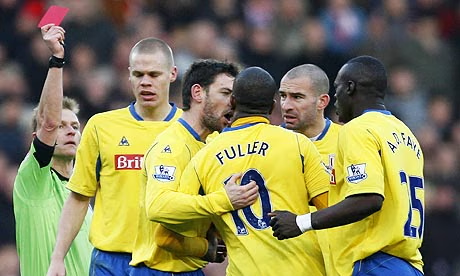
If Bowyer and Dyer was an explosion, Ricardo Fuller’s dismissal was a sharp, sudden crack.
Stoke City were playing West Ham. Carlton Cole had just equalised. Fuller and captain Andy Griffin exchanged words. It looked like nothing. The sort of irritation that bubbles up and fades every weekend.
Then Fuller reached around a teammate who was trying to calm things down and slapped Griffin clean across the face.
The action was quick and unmistakable. The referee produced a red card. Stoke went on to lose 2-1. Tony Pulis looked on with the expression of a man whose day had just gotten significantly worse.
Later explanations leaned heavily on phrases like heat of the moment and misunderstanding. Fuller would say it made the team stronger, which is the kind of revisionist history that sounds good in hindsight. Griffin would play it down. Time did its usual work of sanding off sharp edges.
The footage remains brutally clear. A professional footballer struck his own captain during open play. Not during a brawl. Not in retaliation. Just because his temper briefly overruled his brain.
It was not dramatic. It was not prolonged. It was pure, avoidable absurdity. The kind of thing that makes you wonder what was said to provoke such a response.
5. Steven Gerrard’s 38-second cameo, 2015
Steven Gerrard’s relationship with Manchester United always carried an edge. His final appearance in the fixture distilled that tension into under a minute.
Liverpool were trailing 1-0 at Anfield at half-time. Gerrard entered the pitch as a substitute, greeted by a roar that expected inspiration. The restart was barely complete when Ander Herrera flew into a challenge.
Gerrard reacted instantly. He stamped on Herrera with a force that left no room for interpretation. Martin Atkinson reached for a straight red card. Gerrard walked off having played for 38 seconds.
There was no attempt at denial. Gerrard apologised afterward. The incident felt less like malice and more like emotional overload. A player defined by intensity finally overwhelmed by it. A legend reduced to a punchline in his final derby.
The speed of the dismissal added to the surreal quality. Fans barely had time to sit down before the story was over. One of the great Premier League careers reduced to a blink-and-you-missed-it footnote in a rivalry that always demanded control.
Brendan Rodgers must have wondered what cosmic force he had angered. Bringing Gerrard on to inspire a comeback and watching him last 38 seconds must rank among the crueller managerial experiences.
SEE ALSO | 10 of the Worst Injuries in Premier League History
4. Idrissa Gueye turns on a teammate, 2025

Seventeen years passed between Premier League red cards for striking a teammate. Idrissa Gueye ended that run at Old Trafford in November.
Everton were tense. Manchester United were pressing. Gueye and Michael Keane clashed verbally after a defensive mix-up in the 13th minute. Pushing followed. Then Gueye slapped Keane.
The force was not dramatic. The intent was clear enough. The referee had no choice. Tony Harrington showed the red card. Gueye walked off. Keane looked more embarrassed than hurt.
Managers talk endlessly about passion and commitment. David Moyes leaned into that language afterwards, acknowledging the emotion while quietly wishing it had found a safer outlet. Something that did not involve assaulting your own centre-back.
Everton won the match 1-0, courtesy of Kiernan Dewsbury-Hall’s effort. That result softened the fallout considerably. Nothing heals internal strife quite like three points at Old Trafford, even if you have to play 77 minutes a man down to get them.
The red card itself sat awkwardly in the category of unnecessary self-sabotage. It lacked the chaos of earlier examples. That almost made it stranger.
3. Youssuf Mulumbu’s long-range delivery, 2013
Youssuf Mulumbu chose efficiency over subtlety.
West Brom were losing 3-1 to West Ham deep into stoppage time in March 2013. Gary O’Neil tugged at Mulumbu as he tried to carry the ball out of his own half. It was a foul. Everyone knew it.
Mulumbu decided to handle the situation himself. He picked up the ball and launched it directly at O’Neil with impressive pace and accuracy.
The referee had not yet blown his whistle. That detail mattered very little. Mulumbu was sent off. The act was so clean, so deliberate, that protest felt pointless. What defence could he possibly offer? That his aim was off?
No serious harm was done. O’Neil brushed it off. Mulumbu walked off with the air of a man who had solved a problem his own way. The match was lost anyway. Why not make a statement?
It was petulance delivered with precision. A red card earned honestly through commitment to the bit. If you are going to get sent off, at least make it memorable.
SEE ALSO | 20 Best Defensive Midfielders in World Football Right Now
2. Gabriel Martinelli’s blink-and-you-miss-it dismissal, 2022
Referees talk about managing moments. Michael Oliver created one that will likely never be repeated.
Arsenal were leading Wolves 1-0 at Molineux in February 2022. Gabriel Martinelli shoved Daniel Podence to delay a throw-in in the 69th minute. Oliver played advantage. Martinelli chased back and fouled Chiquinho seconds later.
Oliver stopped play and called Martinelli over. He produced a yellow card for the first foul. Then another yellow card for the second. Then a red.
Three cards in the space of a few seconds. One player sent off for two separate acts committed under a single continuous wave of momentum.
Mikel Arteta later described it as something he had never seen before. The description felt accurate without needing embellishment. The technical correctness of the decision made it more absurd, not less.
The decision was right. That somehow made it funnier. Martinelli accepted his fate with the stunned look of someone who had misjudged the rules of time itself. He seemed genuinely baffled that Oliver had held onto the first yellow for so long.
Arsenal held on to win 1-0, which helped. Martinelli had achieved something genuinely rare. Most players take years to accumulate yellow cards. He managed two inside ten seconds.
1. Everton’s six minutes of madness, 2026

Bizarre red cards tend to arrive alone. Everton decided to double down spectacularly.
The match against Wolverhampton Wanderers was drifting toward a 1-1 draw on a Wednesday night. In the 83rd minute, Michael Keane grabbed Tolu Arokodare by the hair during a tussle. VAR reviewed it. The law was clear. Keane was sent off.
Hair-pulling sits quietly in the rulebook, rarely used in the men’s game. When it appears, it arrives without mercy. Keane seemed genuinely surprised, as if he had stumbled into a regulation last seen in a different sport. The women’s game had set the precedent. Keane had apparently missed that memo.
Everton appealed the decision. The appeal did little to change the image of their goalscorer yanking hair like a toddler in a playground dispute.
Then Jack Grealish, on loan from Manchester City, decided to compound the misery. He reacted to the red card with exaggerated disbelief. Yellow card for dissent. Fair enough. Players complain.
Three minutes later, still smarting over the decision, he applauded sarcastically when referee Thomas Kirk gave a free kick his way. The referee responded automatically. Second yellow. Red card.
Two dismissals. Two different flavours of silliness. Six minutes that managed to turn a routine draw into a disciplinary case study. One for hair-pulling, one for sarcastic clapping.


